
What's Happening?
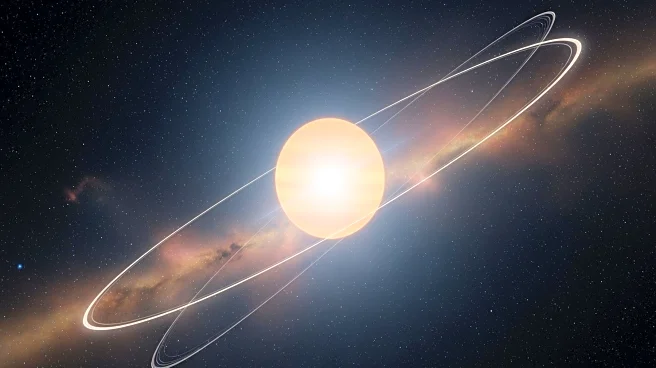
Astronomers have discovered a planet, TOI-3884b, with a highly unusual orbit around its star. The planet's orbit is tilted by approximately 62 degrees relative to the star's rotation axis, a phenomenon
that has puzzled scientists. This discovery was made through detailed observations of starspots on the star's surface, which provided insights into the planet's orbit and the star's behavior. The study, published in The Astronomical Journal, revealed that the star completes a full rotation every 11.05 days. The extreme tilt of TOI-3884b's orbit is not explained by the presence of other massive stars or planets, making it a unique case in planetary science.
Why It's Important?
The discovery of TOI-3884b's tilted orbit challenges existing theories about planetary system stability and formation. Typically, such a significant tilt is attributed to gravitational interactions with other massive celestial bodies, but no such bodies have been detected in this system. This finding opens new avenues for understanding how planets and stars interact and evolve. It could lead to a reevaluation of current models of planetary system dynamics and stability, potentially impacting our understanding of exoplanetary systems and their formation processes.
What's Next?
Future research will likely focus on investigating the potential causes of TOI-3884b's unusual orbit. Scientists may explore alternative explanations, such as past events or interactions that could have led to the current orbital configuration. Continued observations and advanced modeling techniques will be crucial in unraveling this mystery. Additionally, this discovery may prompt astronomers to reexamine other planetary systems for similar anomalies, potentially leading to broader insights into the diversity and complexity of planetary orbits.
Beyond the Headlines
The findings regarding TOI-3884b's orbit could have broader implications for our understanding of planetary system formation and evolution. The absence of massive companions in the system suggests that other, less understood processes might influence planetary orbits. This could lead to new theories about the forces shaping planetary systems, influencing future research in astronomy and astrophysics. The study also highlights the importance of photometric monitoring and starspot analysis in uncovering the dynamics of distant planetary systems.