




What's Happening?
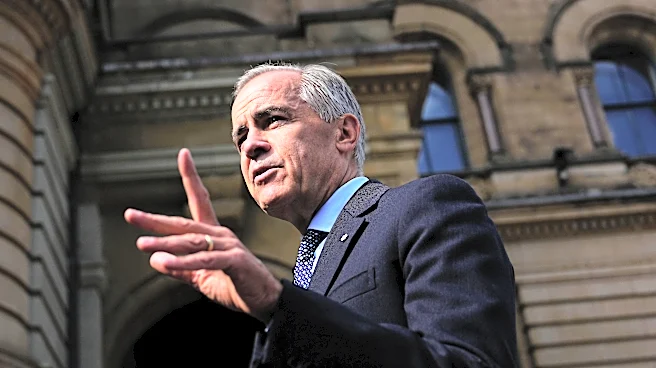
During an appearance on 'The View,' Senator Ted Cruz graded President Trump's economic performance and handling of prices with an 'A,' which was met with immediate groans and disagreement from the hosts and audience. Host Sunny Hostin pressed Cruz for a specific
grade, and despite initial reluctance, he ultimately gave the 'A.' Joy Behar challenged Cruz, stating, 'No, come on. Come on, it's us. It's just us,' implying a call for honesty among familiar faces. Cruz defended his stance by acknowledging the hosts' dislike for President Trump but asserted that differing views are part of democracy. He cited gas prices, tax cuts, and investments as positive economic indicators under the Trump administration, even as current gas prices are noted to be higher again.
Why It's Important?
This exchange highlights the deep partisan divide in the U.S. regarding economic perceptions and the legacy of political administrations. Senator Cruz's defense of President Trump's economic policies, particularly his emphasis on tax cuts and investments, reflects a common Republican viewpoint that prioritizes supply-side economics and deregulation as drivers of prosperity. The hosts' and audience's reaction on 'The View' underscores a contrasting perspective, likely focusing on issues such as inflation, income inequality, or the overall cost of living for average Americans. This public disagreement on a widely watched national television program illustrates how economic data and policy impacts are often interpreted through a political lens, influencing public opinion and potentially shaping future electoral outcomes. The discussion also touches on the role of media platforms in facilitating, or sometimes exacerbating, these political divisions.
What's Next?
The segment on 'The View' is likely to fuel further discussions across various media outlets regarding economic policy and political accountability. Senator Cruz's comments may be used by supporters of President Trump to bolster arguments for his economic record, while critics may leverage the hosts' reactions to highlight perceived shortcomings or selective interpretations of economic data. This type of televised debate often contributes to the ongoing national conversation about economic conditions, influencing voter sentiment as the next election cycle approaches. Political figures and commentators may continue to cite or refute Cruz's 'A' grade, keeping the economic performance of past and present administrations a prominent topic in public discourse. The show's commitment to hosting guests with diverse viewpoints suggests that similar contentious discussions will continue to be a feature of its programming.
Beyond the Headlines
The interaction on 'The View' transcends a simple policy debate, touching upon the broader cultural and political polarization prevalent in the U.S. The hosts' and audience's visceral reaction to Senator Cruz's grade for President Trump's economy suggests that economic assessments are often intertwined with personal political identities and values. This phenomenon, where objective economic indicators are filtered through partisan loyalties, can make it challenging to achieve consensus on policy solutions. The exchange also highlights the role of popular talk shows in shaping public perception and serving as a battleground for ideological clashes. The emphasis on 'it's just us' by Joy Behar, while intended to encourage candor, also subtly points to the expectation of shared political alignment within certain social or media circles, underscoring the challenges of bridging deep-seated political divides in contemporary American society.