

What's Happening?
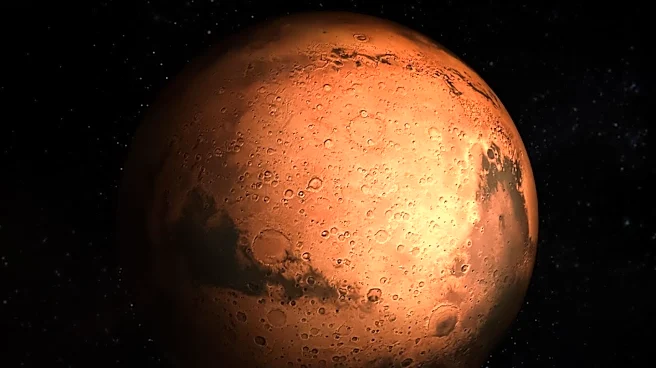
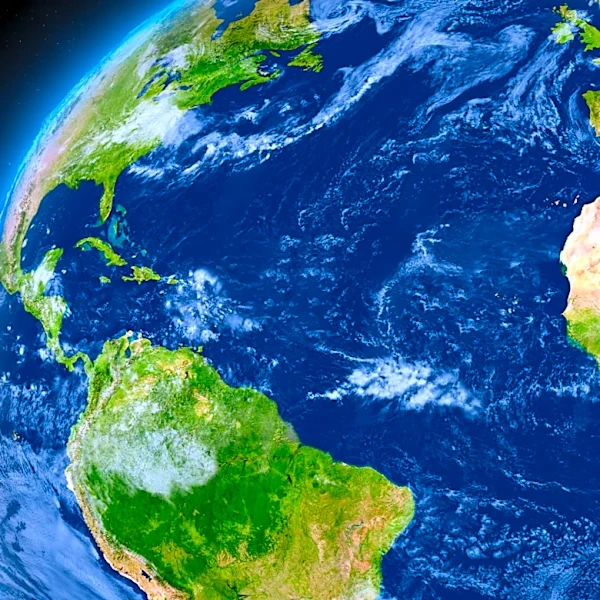
Mars, despite being roughly half the diameter of Earth, possesses a total surface area that is nearly equivalent to all of Earth's continents combined. This surprising comparison arises because oceans cover approximately 71% of Earth's surface, whereas
modern Mars lacks permanent bodies of liquid water. Mars has a mean radius of about 3,390 kilometers, compared to Earth's 6,371 kilometers, making its volume only about 15% of Earth's. However, when considering only the landmass, Mars's surface area is approximately 145 million square kilometers, which is about 97% of Earth's land area of roughly 149 million square kilometers. This comparison highlights a unique aspect of planetary geography rather than indicating similar overall planetary sizes or habitability. While Mars does not have surface liquid water, it holds significant water ice in its polar caps and beneath its surface, with possible underground liquid reservoirs still under investigation.
Why It's Important?
This comparison is significant for understanding the scale of Mars and its potential for future exploration and settlement. While the statistic doesn't imply similar habitability, it provides a tangible measure for mapping and planning potential Martian missions. The vast exposed surface area of Mars, largely shaped by ancient liquid water, offers extensive terrain for scientific study, resource extraction, and the establishment of human outposts. Understanding the distribution of this landmass, its geological features, and the presence of water ice is crucial for mission planning, including identifying suitable landing sites and resource utilization strategies. The absence of a global ocean on Mars means that nearly its entire surface is accessible for exploration, contrasting sharply with Earth where most of the solid planet is submerged. This perspective helps in conceptualizing the logistical challenges and opportunities associated with long-term human presence on Mars.
What's Next?
Future Martian missions will continue to focus on detailed mapping and characterization of its surface, particularly in areas identified as having potential water ice reserves or geological features indicative of past water activity. Ongoing research will aim to confirm the existence and extent of subsurface liquid water reservoirs, which could be vital for sustaining future human settlements. Technological advancements in rover capabilities and remote sensing will enable more precise surveys of the Martian terrain, identifying optimal locations for scientific research and potential human habitats. Furthermore, the data gathered will inform the design of future spacecraft and life support systems, tailored to the unique environmental conditions of Mars's extensive landmass. The continued exploration will refine our understanding of Mars's geological history and its potential to harbor life, past or present.
Beyond the Headlines
The comparison between Mars's surface area and Earth's landmass underscores a fundamental difference in planetary evolution and highlights Earth's unique hydrological cycle. It prompts deeper consideration of what constitutes a 'habitable' planet, moving beyond mere surface area to factors like atmospheric density, thermal buffering, and protection from radiation. The fact that Mars, a smaller planet, offers a comparable land area to Earth's continents emphasizes the rarity of Earth's vast oceans and their role in shaping our planet's climate and biodiversity. This perspective can influence astrobiological research, guiding the search for extraterrestrial life by broadening the criteria for potential habitability beyond Earth-like conditions. It also encourages a re-evaluation of how we perceive planetary 'real estate' for future human expansion, emphasizing that accessibility and resource availability are more critical than sheer exposed area.