







What's Happening?
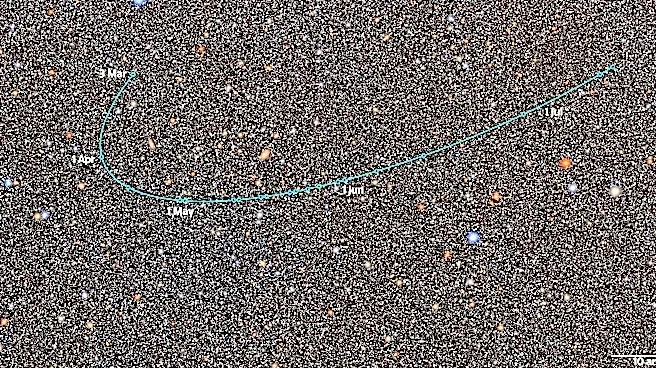
Astronomers utilizing the NSF–DOE Vera C. Rubin Observatory in Chile have identified a significant celestial object, provisionally designated ED138, in the outer solar system beyond Pluto. This object is considered a strong candidate for a new dwarf planet,
potentially ranking among the largest ever found. The discovery was made possible by the Rubin Observatory's advanced camera and sophisticated data algorithms, which enable it to meticulously capture changes across the southern hemisphere sky. ED138 was located in a star-dense region near the Milky Way's plane, which likely contributed to its previous undetected status. If confirmed, ED138 would join the five currently recognized dwarf planets: Pluto, Ceres, Eris, Haumea, and Makemake. The International Astronomical Union Minor Planet Center has assigned its provisional designation, and scientists are now conducting follow-up observations to gather more data on its characteristics.
Why It's Important?
The potential discovery of ED138 holds significant importance for understanding the formation and evolution of our solar system. Each new celestial body found in the Kuiper Belt region provides valuable data that can refine existing models of planetary migration and the early solar system's dynamics. The Rubin Observatory's capability to detect such objects in crowded stellar fields demonstrates a leap in astronomical observation technology, allowing for the identification of previously hidden bodies. This discovery also underscores the ongoing re-evaluation of what constitutes a planet and a dwarf planet, as defined by the International Astronomical Union. Further study of ED138's orbital characteristics and composition could offer insights into the diverse range of objects inhabiting the solar system's distant reaches, potentially revealing clues about its primordial conditions.
What's Next?
The immediate next step involves extensive follow-up observations of ED138 by scientists using other observatories. These observations are crucial for gathering more detailed information about its size, albedo (surface reflectivity), orbital path, and physical composition. Such data will be essential for confirming its dwarf planet status according to the International Astronomical Union's criteria, which require it to orbit the Sun, be nearly round, and not have cleared its orbital neighborhood. The Rubin Observatory will continue its regular monitoring, which has already led to the discovery of over 11,000 new asteroids this year. The ongoing Legacy Survey of Space and Time (LSST) by the Rubin Observatory is designed to repeatedly survey the southern sky over approximately 10 years, promising further discoveries of previously undetected celestial objects and a deeper understanding of the outer solar system.
Beyond the Headlines
The discovery of ED138 extends beyond a mere addition to the solar system's catalog; it highlights the profound impact of advanced observational technology on our cosmic understanding. The Rubin Observatory's ability to discern subtle movements within densely populated star fields represents a paradigm shift in astronomical detection, opening up new avenues for exploring the universe's hidden corners. This ongoing exploration challenges and refines our definitions of celestial bodies, prompting a deeper philosophical consideration of our place within the cosmos. The continuous unveiling of new objects like ED138 reinforces the dynamic and ever-evolving nature of our solar system, suggesting that many more secrets remain to be uncovered in its distant, icy frontiers. This ongoing quest for discovery not only expands scientific knowledge but also fuels public fascination with space exploration and the mysteries of the universe.