







What's Happening?
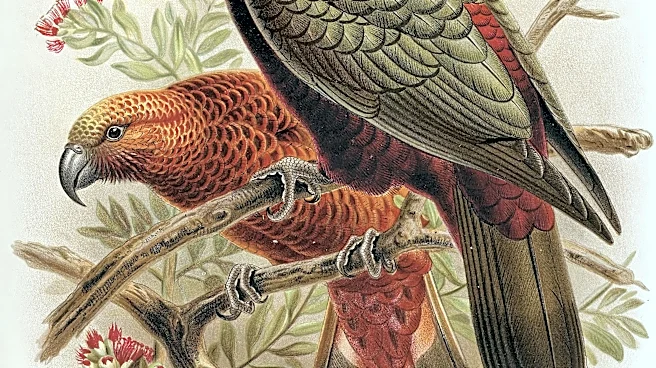
John James Audubon's seminal work, 'The Birds of America,' is being recognized for its significant contribution to natural history illustration. A generation after Enlightenment engravers focused on detailed natural world depictions, Audubon's work presented
perhaps the most realistic natural history illustrations of its time. His collection features life-size depictions of various bird species, including herons, warblers, and owls, rendered with exquisite precision. This artistic and scientific endeavor is highlighted in the context of a long tradition of humans depicting other beings, from ancient cave paintings to the advent of photography. Audubon's meticulous approach to capturing the natural world set a high standard for realism in scientific illustration.
Why It's Important?
John James Audubon's 'The Birds of America' holds immense importance in both scientific and artistic communities within the U.S. and globally. Scientifically, his detailed and life-size illustrations provided an unprecedented level of accuracy for ornithological study, aiding in the identification and understanding of North American bird species. Artistically, his work is considered a masterpiece, blending scientific rigor with aesthetic beauty, influencing generations of wildlife artists and illustrators. The book's impact extends to conservation efforts, as it raised public awareness and appreciation for avian biodiversity, contributing to the early environmental movement. For the U.S., Audubon's work is a cultural touchstone, representing a pivotal moment in the documentation of its natural heritage and establishing a legacy that continues through organizations like the National Audubon Society.
What's Next?
The enduring legacy of John James Audubon's 'The Birds of America' ensures its continued relevance in natural history, art, and conservation. Future generations will likely continue to study and admire his work for its scientific accuracy and artistic merit. Modern conservation efforts, often inspired by such foundational works, will continue to draw attention to the importance of documenting and protecting biodiversity. Exhibitions of Audubon's prints and scholarly analyses of his methods will persist, further cementing his place in the history of science and art. Educational programs will also continue to use his illustrations to teach about ornithology and the history of natural science, ensuring his influence remains strong.
Beyond the Headlines
Audubon's 'The Birds of America' transcends mere illustration; it represents a profound shift in how humans perceived and documented the natural world. His dedication to life-size, precise depictions reflected a growing scientific curiosity and a desire to understand nature on its own terms, moving beyond symbolic or idealized representations. This work also highlights the intersection of art and science, demonstrating how artistic skill can serve scientific inquiry and vice versa. Furthermore, the sheer scale and ambition of 'The Birds of America' underscore the entrepreneurial spirit of its time, as Audubon undertook a monumental project that required extensive travel, observation, and artistic execution. His legacy also raises questions about the ethics of collecting specimens for scientific study, a practice that was common in his era but is viewed differently today, prompting reflection on the evolution of scientific and conservation practices.