
What's Happening?
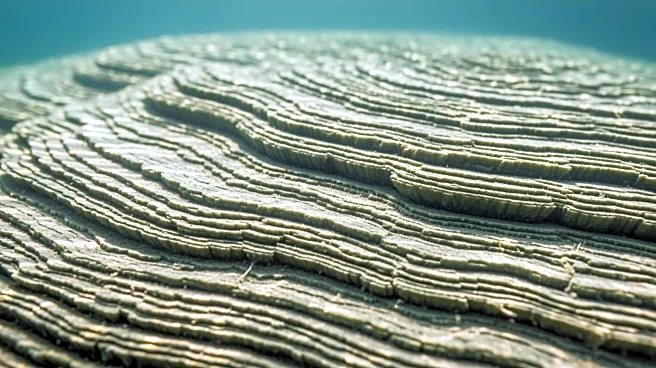
Researchers from Bigelow Laboratory for Ocean Sciences and Rhodes University have discovered that microbialites along the South African coast are highly efficient at absorbing carbon. These 'living rocks'
are formed by microbes that precipitate dissolved minerals into solid formations, similar to coral reefs. The study, published in Nature Communications, reveals that these microbialites can absorb carbon both day and night, utilizing photosynthesis and other metabolic processes. This discovery challenges previous assumptions that these systems were solely driven by photosynthesis. The microbialites are capable of absorbing significant amounts of carbon dioxide annually, making them one of the most efficient natural mechanisms for carbon storage.
Why It's Important?
The findings have significant implications for understanding natural carbon sequestration processes. As climate change continues to be a pressing global issue, identifying efficient natural carbon sinks is crucial. The ability of these microbialites to absorb carbon at rates comparable to large forested areas highlights their potential role in mitigating carbon emissions. This research could inform future environmental policies and conservation efforts aimed at enhancing natural carbon sinks. Additionally, understanding the metabolic processes of these microbial communities could lead to innovations in biotechnology and environmental management.
What's Next?
The research team plans to continue studying the environmental factors and microbial variations that influence carbon uptake in these systems. By integrating interdisciplinary expertise, they aim to further unravel the complex interactions within these microbial communities. This ongoing research could provide deeper insights into the resilience and adaptability of microbialites, potentially leading to new strategies for enhancing carbon sequestration in other ecosystems.
Beyond the Headlines
The study underscores the importance of looking beyond traditional assumptions in scientific research. By exploring unexpected findings, such as the nighttime carbon uptake, researchers can uncover novel insights that challenge existing paradigms. This approach not only advances scientific knowledge but also highlights the value of diverse perspectives and interdisciplinary collaboration in addressing complex environmental challenges.