







What's Happening?
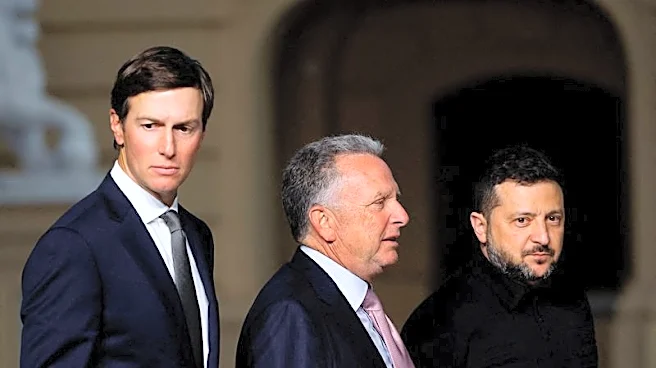
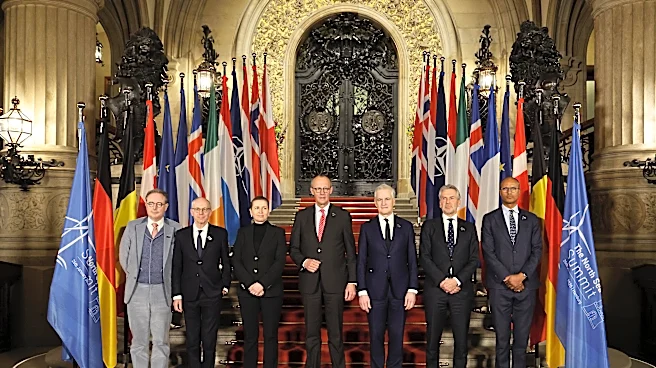
The European Union (EU) announced it will host a high-level security meeting with the United States and Ukraine on November 4, 2026, in Brussels, Belgium. Representatives from EU member states France and Germany, the United Kingdom, the North Atlantic
Treaty Organization (NATO), and the World Bank will also participate. This meeting builds upon previous discussions held in Miami on October 9 and Oslo, Norway, on October 20. The agenda includes Ukraine's security guarantees, economic support for reconstruction, and its future. NATO spokesperson Allison Hart confirmed that discussions will also focus on achieving a fair and lasting end to the war in Ukraine. This gathering precedes trilateral working-level talks between the U.S., Russia, and Ukraine scheduled for November 10-11 in Abu Dhabi, United Arab Emirates.
Why It's Important?
This high-level meeting is crucial for the U.S. as it reinforces transatlantic unity and commitment to Ukraine's sovereignty and security. U.S. participation underscores its leadership role in coordinating international efforts to support Ukraine against Russian aggression. The discussions on security guarantees and economic reconstruction are vital for stabilizing the region and preventing further escalation, which directly impacts U.S. national security interests and global stability. By engaging with key European allies and international organizations, the U.S. aims to ensure a cohesive strategy for Ukraine's long-term recovery and integration into the Euro-Atlantic community. This also serves to counter Russian influence and uphold international law, which are core tenets of U.S. foreign policy.
What's Next?
The outcomes of this meeting are expected to inform the trilateral working-level talks between the U.S., Russia, and Ukraine in Abu Dhabi on November 10-11. These discussions will likely shape the diplomatic approach to resolving the conflict in Ukraine, including potential ceasefire agreements, peace negotiations, and post-conflict reconstruction efforts. The continued coordination among the U.S., EU, UK, and NATO will be essential in presenting a united front and leveraging collective influence. Future economic aid packages, military assistance, and diplomatic initiatives for Ukraine will likely be influenced by the agreements reached during these high-level consultations. The international community will be closely watching for any breakthroughs or shifts in diplomatic strategies.
Beyond the Headlines
The meeting's focus on Ukraine's future and security guarantees extends beyond immediate conflict resolution, touching upon the broader architecture of European security. The involvement of the World Bank signals a recognition that economic stability and reconstruction are integral to lasting peace, highlighting the interconnectedness of security and economic development. For the U.S., this engagement is also about demonstrating the efficacy of multilateral diplomacy and alliances in addressing complex global challenges. The discussions implicitly address the long-term implications of the conflict for international norms, the role of great powers, and the sovereignty of smaller nations. The ongoing dialogue aims to establish a precedent for how future geopolitical disputes might be managed, emphasizing cooperation over unilateral action.