




What's Happening?
Red crown rot, a fungal disease caused by *Calonectria ilicicola*, is rapidly spreading across soybean fields in Illinois and other Midwestern states, including Indiana, Iowa, Kentucky, Missouri, Nebraska, Ohio, and Wisconsin. First identified in Illinois in 2018,
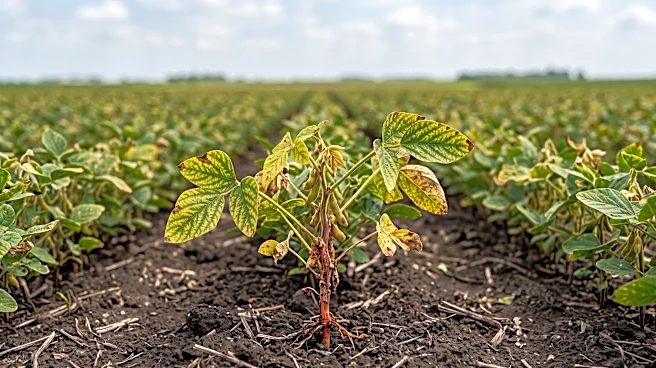
the disease can lead to yield reductions of up to 60-70%. Boris Camiletti, a plant pathologist at the University of Illinois Urbana-Champaign, is leading research efforts to understand and combat the pathogen. The fungus resides in the soil, with hardy microsclerotia structures that can persist for several years. Infection occurs when these microsclerotia germinate, producing hyphae that penetrate root cells and release toxins, ultimately killing plant tissue. Symptoms often begin at the root crown, appearing as a reddish tinge on the stem and lower crown, sometimes accompanied by white patches or brick-red spore-producing spheres. Foliar symptoms, such as yellowing between veins followed by leaf death, typically become visible during the reproductive stages (R3-R5) of soybean growth. These foliar symptoms can be easily mistaken for other common soybean diseases like sudden death syndrome or brown stem rot, making early detection challenging.
Why It's Important?
The widespread and increasing prevalence of red crown rot poses a significant threat to the U.S. soybean industry, particularly in the Midwest, a major agricultural region. With potential yield losses reaching 60-70% in severely affected areas, farmers face substantial economic repercussions. The difficulty in distinguishing red crown rot from other diseases based solely on foliar symptoms means that the true extent of its spread may be underestimated, leading to delayed or incorrect management strategies. The persistence of the fungus in the soil for several years also complicates control efforts, as traditional crop rotation methods may not be effective. This situation highlights the vulnerability of agricultural systems to emerging plant pathogens and the critical need for ongoing research and development of effective disease management solutions. The economic impact extends beyond individual farmers, potentially affecting commodity prices, agricultural supply chains, and regional economies reliant on soybean production.
What's Next?
Researchers, including Boris Camiletti and his team, are actively testing various soybean varieties and seed treatments to identify effective resistance and control methods. They are also initiating a project to develop a decision-support system for farmers, utilizing satellite imagery, field data, and machine learning. This system aims to help producers make informed economic decisions regarding disease management by mapping affected areas and calculating the return on investment for different treatments. The Crop Protection Network will deliver practical tools, including a Disease-Area Estimator and an ROI Calculator, to assist farmers in targeting disease management investments more effectively. Growers are advised to consult their seed dealers for information on variety resistance and to submit suspicious plant samples to extension plant clinics for accurate diagnosis. Continued efforts will focus on improving scouting, screening, and understanding the interactions between seed treatments and soybean varieties to mitigate the disease's impact.
Beyond the Headlines
The emergence and rapid spread of red crown rot underscore broader challenges in agricultural sustainability and food security. The disease's ability to mimic other common soybean ailments highlights the complexity of plant pathology and the need for advanced diagnostic tools. The long-term persistence of the pathogen in the soil suggests that conventional agricultural practices may need to evolve to address such resilient threats. This situation also brings to light the interconnectedness of agricultural ecosystems, where factors like soil movement and machinery can contribute to disease dissemination. The collaborative research efforts involving universities, industry partners, and farmer associations demonstrate the importance of a multi-faceted approach to tackling agricultural crises. Furthermore, the development of data-driven decision-making tools, such as those utilizing satellite imagery and machine learning, represents a significant step towards more precise and economically sound disease management, potentially setting a precedent for addressing future agricultural challenges.