


What's Happening?
The Metropolitan Transportation Authority (MTA) is under criticism for its handling of major transit projects in New York, specifically regarding inflated costs and design decisions. A report highlights that projects like the Grand Central Madison (GCM)
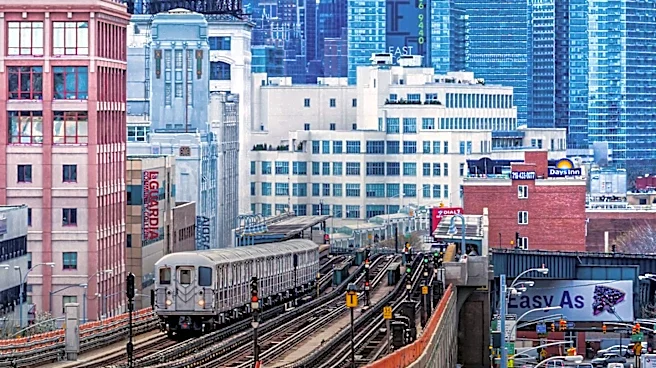
and the Second Avenue Subway (SAS) Phase 1 have been plagued by issues such as unneeded spaces, features, and a reluctance to undertake surface disruption, which significantly increases construction costs. The GCM project, for instance, saw its final plan centered on building two massive new caverns 140 feet under Grand Central Terminal due to disagreements between MTA's commuter railroads and an overly conservative analysis of track grades, rather than utilizing existing lower levels. Similarly, for SAS West, despite difficult ground conditions with loose sand, gravel, and a high water table, the MTA's current plans avoid modern cut-and-cover construction methods, opting instead for deeper stations and vertical shafts with multiple escalator switchbacks. This approach is driven by an 'unquestioned assumption' that cut-and-cover must be avoided, leading to more expensive construction and permanently worse station access, as seen in the deepening of the 125 St/Lexington Av station by 20 feet to avoid surface impacts.
Why It's Important?
The MTA's current project management and design philosophy have significant implications for New York's transit infrastructure and public finances. The avoidance of modern cut-and-cover construction methods, despite their proven effectiveness in challenging conditions, leads to deeper, more complex, and ultimately more expensive stations. This not only burdens taxpayers with higher costs but also results in less convenient access for commuters, increasing walking distances and travel times. The report suggests that the MTA's reticence to undertake surface disruption, while aiming to mitigate neighborhood opposition, paradoxically raises construction costs without necessarily achieving its goal. This approach contrasts with global norms for transit construction, where cost-effective methods are prioritized. The continued reliance on outdated or overly conservative design choices means that New York is not building the transit it needs efficiently, impacting economic development, environmental sustainability, and the daily lives of millions of commuters. The lack of cost reduction despite proclamations of savings on projects like SAS Phase 2 further erodes public trust and accountability.
What's Next?
To address these issues, the MTA needs to seriously re-evaluate its construction methodologies and cost management strategies. The report suggests that the agency must reconsider its aversion to surface disruption and explore modern cut-and-cover techniques, such as the Milan method, which are effective even in high-water table conditions and can limit surface impacts. Implementing these proven technologies could lead to more cost-effective construction and better station access. Furthermore, the MTA should review its procurement processes and design standards to align them with global best practices, potentially reducing the 'bloated projects' and 'unneeded spaces' that contribute to excessive costs. Stakeholders, including transit advocates, local communities, and government oversight bodies, will likely continue to pressure the MTA for greater transparency, accountability, and efficiency in its future projects. The success of upcoming phases of the Second Avenue Subway and other critical infrastructure developments will depend on the MTA's willingness to adapt and learn from past missteps, ensuring that New York can build the transit it needs within reasonable financial and operational parameters.
Beyond the Headlines
The challenges faced by the MTA extend beyond mere construction costs and design choices; they reflect deeper systemic issues within large public infrastructure projects in the U.S. The 'unquestioned assumption' against certain construction methods, driven by a fear of neighborhood opposition or perceived difficulties, highlights a broader institutional inertia that can hinder innovation and efficiency. This often leads to a trade-off where temporary construction-induced noise and traffic are avoided at the expense of permanently worse station access and significantly higher costs. The report implicitly raises questions about the balance between community concerns, engineering feasibility, and long-term public benefit. The reliance on 'overly conservative design' and 'overscoping' suggests a risk-averse culture that prioritizes perceived safety and minimal disruption over cost-effectiveness and optimal user experience. Addressing these underlying cultural and institutional factors is crucial for the MTA to bring its costs in line with global norms and deliver transit projects that truly serve the public interest, fostering a more sustainable and accessible urban environment for future generations.