




What's Happening?
Minister for Foreign Affairs Shisir Khanal of Nepal has urged stronger global climate action, emphasizing the need for increased climate finance, support for loss and damage, and greater international attention to mountain vulnerabilities. This call comes
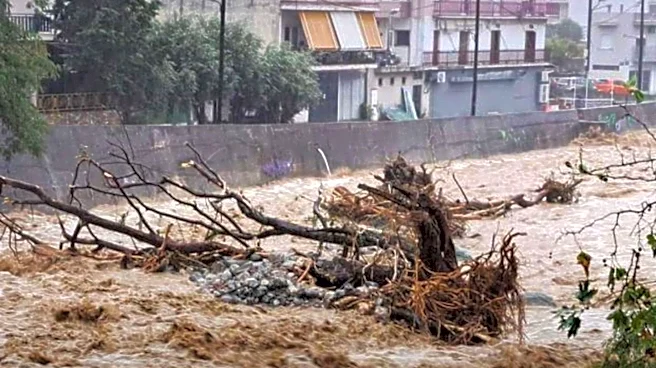
after devastating floods on August 26 inflicted immense human suffering and extensive damage upon Nepal's infrastructure, livelihoods, and economy. Preliminary assessments indicate that reconstruction and recovery from this catastrophe alone will require approximately US$4.7 billion, which is nearly ten percent of Nepal's national GDP. Minister Khanal addressed the National Climate Summit 2026, held in anticipation of COP31 in Antalya, Turkiye, from November 9 to November 20, 2026. He highlighted that behind these figures are families mourning loved ones, communities struggling to rebuild, and decades of development gains jeopardized. Nepal has consistently advocated for mountain concerns through initiatives like the International Expert Dialogue on Mountains, People and Climate Change and the Sagarmatha Sambaad.
Why It's Important?
Nepal's plea for stronger global climate action underscores the disproportionate impact of climate change on vulnerable nations, particularly those with significant mountain ecosystems. The estimated US$4.7 billion required for recovery highlights the severe economic burden placed on a developing country by climate-induced disasters, diverting resources from other critical development priorities. This situation is important for the U.S. as it emphasizes the global interconnectedness of climate change and the moral and strategic imperative for developed nations to support climate finance and loss and damage mechanisms. The call for dedicated attention to mountain vulnerabilities is crucial, as these regions are often overlooked despite being highly susceptible to climate impacts like glacial melt and extreme weather events, which can have downstream effects on water resources and ecosystems globally. The U.S. role in international climate negotiations and funding will be critical in addressing these concerns.
What's Next?
Nepal will continue to advocate for its priorities at COP31, including regular high-level dialogues on mountains, a dedicated mountain work program, and the systematic integration of mountain-specific vulnerabilities into global climate frameworks. The recent provisional allocation of US$20 million from the Fund for Responding to Loss and Damage, with Nepal being the first recipient, marks a significant milestone, and Nepal will push for predictable, grant-based resources and effective rapid-response mechanisms. The Ministry of Foreign Affairs has established a dedicated Climate Diplomacy Section to advance these national priorities through bilateral diplomacy, regional partnerships, and multilateral cooperation. The government is also preparing documents for COP31, focusing on climate change adaptation, easier access to climate finance, and the effective operation of the loss and damage fund.
Beyond the Headlines
The devastating floods in Nepal are a stark illustration of the 'loss and damage' concept in climate change discourse, where countries that have contributed least to global emissions bear the brunt of its impacts. This raises profound questions of climate justice and equity on the international stage. The long-term implications extend beyond immediate reconstruction to include food security, public health, and the preservation of unique biodiversity in mountain regions. The need for a 'just transition' and inclusive climate justice, as highlighted by Minister for Agriculture, Forest and Environment Geeta Chaudhary, emphasizes that climate policies must prioritize vulnerable communities, including women, children, indigenous peoples, and marginalized groups. This event serves as a critical case study for how global climate action must evolve to address both mitigation and adaptation, alongside robust mechanisms for loss and damage, to prevent further humanitarian and economic crises.