






What's Happening?
Katherine Whitaker, affiliated with the University of Massachusetts - Amherst, is leading a significant project titled 'Fulfilling the UV Legacy of the Hubble and Webb Deep Public Frontier Field.' This initiative has been allocated 72 orbits of observation
time by the Hubble Telescope Allocation Committee (TAC). The project is listed under Cycle 32 of the Hubble programs, indicating a recent and ongoing allocation of resources for this research. Whitaker is also noted for a previous project in Cycle 24, 'A Chance Alignment: Resolving a Massive Compact Galaxy Actively Quenching at z=1.8,' which received 12 orbits.
Why It's Important?
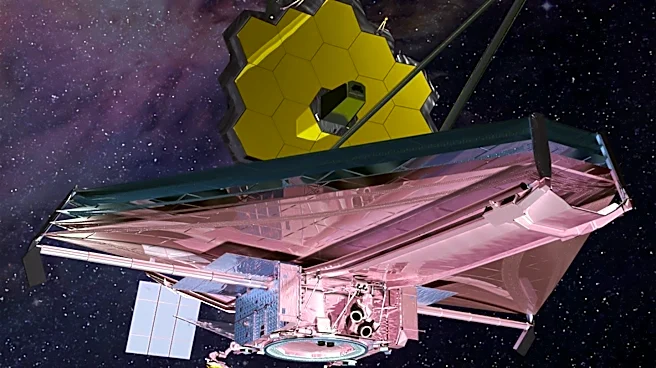
This project is crucial for advancing our understanding of the universe, particularly in the field of ultraviolet (UV) astronomy. By leveraging both the Hubble Space Telescope's established capabilities and the upcoming James Webb Space Telescope's (JWST) advanced instruments, Whitaker's team aims to extend the legacy of UV observations. The 'Deep Public Frontier Field' likely refers to a region of space targeted for extensive study, providing data that can reveal insights into galaxy formation, evolution, and the early universe. The substantial allocation of observation time underscores the project's scientific merit and its potential to yield groundbreaking discoveries, impacting the broader astronomical community and contributing to the U.S.'s leadership in space science.
What's Next?
The project will proceed with the allocated 72 orbits of observation time from the Hubble Space Telescope. The mention of the James Webb Space Telescope suggests that future phases of this research will integrate data from JWST, once it becomes fully operational and its data is available. This multi-observatory approach will allow for a more comprehensive and detailed study of the targeted deep field. The findings from this research are expected to be published in scientific journals, contributing to the global body of astronomical knowledge and potentially informing future space missions and research priorities.
Beyond the Headlines
The collaboration between the Hubble and James Webb Space Telescopes, as highlighted by Whitaker's project, represents a strategic evolution in astronomical research. It signifies a shift towards integrated observational strategies that maximize the unique strengths of different space-based observatories. This approach not only enhances data collection but also fosters international scientific cooperation and technological innovation. The 'UV Legacy' aspect emphasizes the long-term vision in space exploration, where current missions lay the groundwork for future discoveries, continually pushing the boundaries of human understanding of the cosmos and inspiring public interest in science and technology.