



What's Happening?
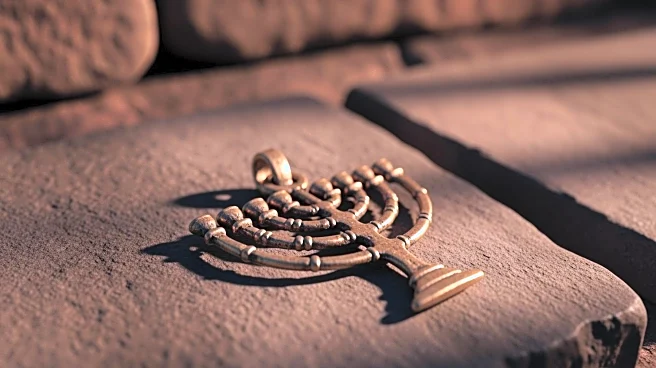
Archaeologists have uncovered a rare 1,400-year-old pendant featuring a seven-branch menorah near the Western Wall in Jerusalem. This discovery, made by the Israel Antiquities Authority in collaboration with the City of David Foundation and the Jewish
Quarter Development Company, provides new insights into Jewish life during the Byzantine period when Jews were officially barred from the city. The lead pendant, which bears identical menorah images on both sides, was found in a fill layer used as a foundation for Umayyad-period structures. The pendant's discovery raises questions about its historical context, as Jews were prohibited from living in Jerusalem during this time. Researchers suggest it may have belonged to a Jewish individual visiting the city discreetly. Dr. Baruch, who has directed the site's excavations for 25 years, emphasized the pendant's significance as a personal seal and a token of memory and identity.
Why It's Important?
The discovery of the menorah pendant is significant as it sheds light on the persistence of Jewish presence and identity in Jerusalem during a period of official prohibition. It highlights the cultural and religious resilience of the Jewish community, who maintained their connection to the city despite imperial edicts. The pendant serves as a tangible link to the past, illustrating the continuity of Jewish tradition and devotion. This find also contributes to the understanding of menorah imagery and its symbolic importance in Jewish culture. The pendant's existence suggests that Jews continued to visit Jerusalem for various reasons, challenging the historical narrative of their absence during the Byzantine period.