





What's Happening?
A new exhibition titled 'Dare Mighty Things: From Rocketry to Space Exploration at Caltech JPL' is showcasing the Jet Propulsion Laboratory's (JPL) ninety-year history of contributions to rocketry and space exploration. The exhibition, drawing from the collections
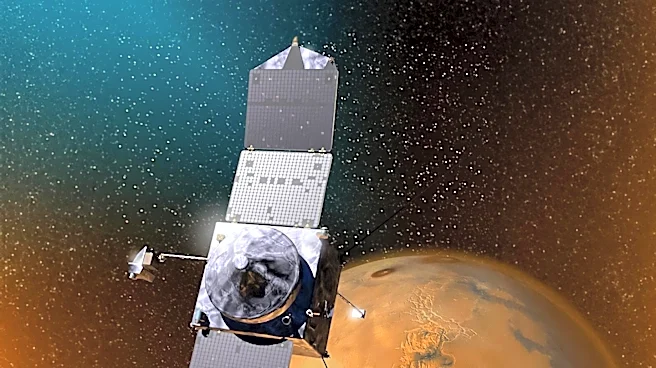
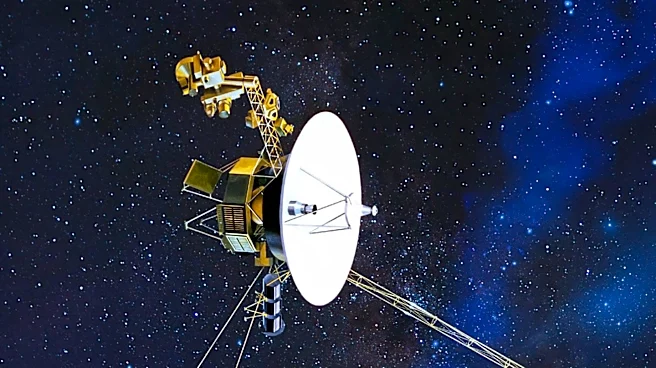
of both the Caltech Archives and Special Collections and the JPL Archives, traces the evolution of JPL's missions and the collaboration between JPL researchers and Caltech. Initially, in the 1930s, Caltech graduate students and rocket enthusiasts began small rocket engine experiments, attracting Army funding for rocket-assisted airplane takeoff. This led to the establishment of JPL in 1943. After the USSR launched Sputnik 1 in 1957, JPL built the first successful U.S. satellite, Explorer 1, in 1958. Following the establishment of NASA, JPL transitioned from Army work to designing uncrewed spacecraft for NASA, playing a pivotal role in lunar missions with Pioneer, Ranger, and Surveyor probes, and later sending Mariner probes to Venus and Mars. JPL also pioneered the use of planetary gravity assists for missions like Voyager 1 and 2's 'Grand Tour' of the outer planets.
Why It's Important?
JPL's historical achievements, as highlighted by this exhibition, are crucial to understanding the foundation and trajectory of U.S. space exploration. The laboratory's rapid growth during World War II and the Cold War, driven by Army support, demonstrates the critical link between national defense and scientific advancement. The transition of JPL to NASA's service after the Sputnik launch underscores a national pivot towards civilian-led space endeavors, shaping the U.S. as a leader in space. JPL's innovations, such as the development of the Explorer 1 satellite and the pioneering use of gravity assists for deep-space missions, were instrumental in expanding humanity's understanding of the solar system. These advancements not only propelled scientific discovery but also fostered technological innovation that had broader applications, influencing industries from computing to materials science. The exhibition serves as a reminder of the long-term investment and collaborative spirit required for monumental scientific undertakings.
What's Next?
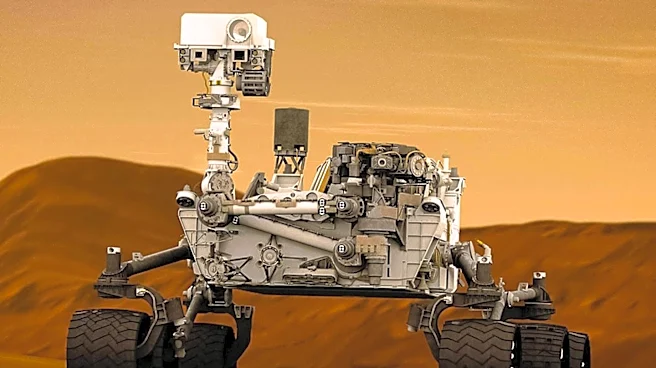
While the exhibition itself is a retrospective, its focus on JPL's foundational role in space exploration implicitly points to the ongoing and future endeavors of the U.S. space program. JPL continues to build new space telescopes and develop more complex spacecraft, aiming to further revolutionize the understanding of planets, moons, stars, and exoplanets. The legacy of missions like Mars Pathfinder and Perseverance, which landed the first rover and helicopter on Mars, respectively, indicates a continued commitment to robotic planetary exploration. The exhibition's emphasis on the motto 'Dare Mighty Things' suggests an enduring ethos of ambitious scientific pursuit. Future U.S. space exploration will likely build upon these historical successes, pushing boundaries in areas such as astrobiology, exoplanet research, and potentially human missions to Mars, leveraging the technological and scientific heritage established by institutions like JPL.
Beyond the Headlines
The 'Dare Mighty Things' exhibition delves deeper than just scientific achievements; it reflects the cultural and intellectual spirit that has driven U.S. innovation. The early challenges faced by rocket pioneers, who were initially dismissed as pursuing 'science fiction,' illustrate the importance of perseverance and visionary thinking in overcoming skepticism. The shift from military-driven rocketry to civilian space exploration under NASA also highlights a broader societal evolution in how scientific and technological capabilities are utilized. This historical narrative underscores the idea that significant breakthroughs often emerge from interdisciplinary collaboration and sustained investment in research and development. The exhibition implicitly encourages future generations to embrace complex scientific challenges, reinforcing the idea that seemingly impossible feats can be achieved through dedication and ingenuity, thereby shaping the nation's scientific literacy and inspiring future innovators.