







What's Happening?
Recent scientific discoveries are significantly re-evaluating the intelligence and capabilities of Neanderthals, challenging long-held perceptions that they were 'thick-skulled savages.' A new skull-based analysis of Neanderthal brains suggests their
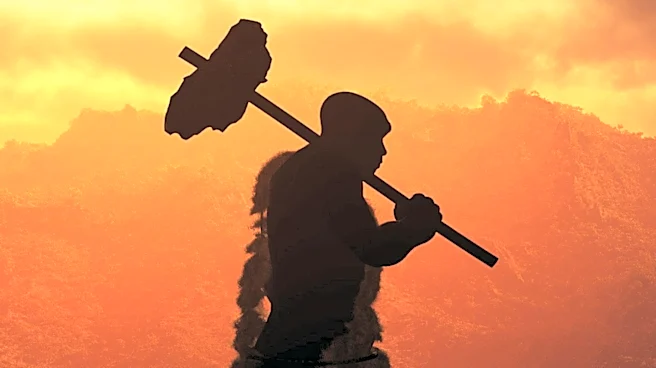
range of intelligence largely overlapped with that of early modern humans. This re-evaluation is supported by findings of sophisticated wooden tools (62-40 thousand years ago) preserved in stone, indicating advanced planning and material knowledge. Dr. Emma Pomeroy from Cambridge’s Department of Archaeology also reported the discovery of a perfectly preserved 75,000-year-old Neanderthal shoulder blade with a round hole, potentially the earliest evidence of lethal interpersonal violence with a wooden spear. These findings collectively paint a picture of Neanderthals as far more complex and intelligent than previously thought, moving away from the brutish image popularized by figures like President Theodore Roosevelt and H.G. Wells.
Why It's Important?
This re-evaluation of Neanderthal intelligence is important because it fundamentally alters our understanding of human evolution and the cognitive abilities of our ancient relatives. By demonstrating that Neanderthals possessed complex cognitive skills, tool-making expertise, and potentially engaged in interpersonal violence, it narrows the perceived intellectual gap between Neanderthals and early Homo sapiens. This shift challenges the notion of a linear, progressive evolutionary path where modern humans were inherently superior. It encourages a more nuanced view of human diversity and the multiple forms intelligence can take. Furthermore, it highlights how scientific understanding evolves with new evidence, correcting historical biases and popular misconceptions that have influenced cultural narratives about prehistoric life.
What's Next?
Future research will likely continue to uncover more evidence of Neanderthal behavior and cognitive abilities, further refining our understanding of their place in human evolutionary history. Advanced analytical techniques, including detailed studies of fossil remains and archaeological sites, will provide deeper insights into their social structures, technological innovations, and interactions with their environment. The ongoing comparison of Neanderthal and Homo sapiens DNA will also shed more light on their genetic relationship and potential interbreeding. This continuous discovery process will challenge existing theories and contribute to a more accurate and comprehensive narrative of human origins, potentially leading to new perspectives on what defines 'human' intelligence and culture.
Beyond the Headlines
The evolving understanding of Neanderthals has profound implications beyond paleontology, touching upon philosophical questions about the nature of the human mind and the limitations of historical evidence. The difficulty in reconstructing the 'history' of the human mind, as noted in the source, underscores the challenge of inferring cognitive processes from material remains. The example of Neanderthal wooden tools demonstrates that intelligence is not solely measured by monumental achievements but also by adaptive ingenuity within environmental constraints. This perspective encourages us to consider how much of our own 'intelligence' is enabled by accumulated technology rather than inherent cognitive superiority. It also serves as a cautionary tale against anthropocentric biases in scientific interpretation, reminding us that our understanding of the past is always subject to revision as new evidence emerges and old assumptions are re-examined.