



What's Happening?
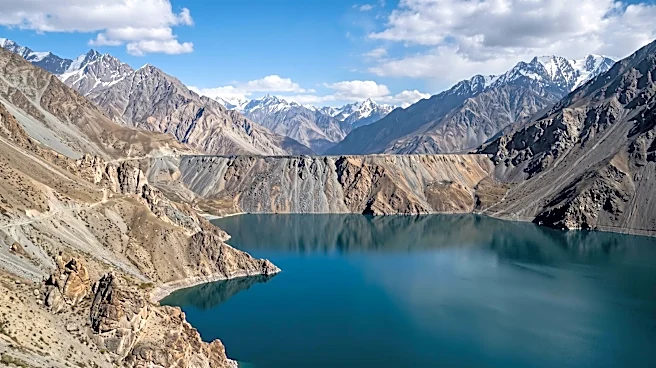
Lake Sarez, located in the Pamir Mountains of Tajikistan at 10,700 feet above sea level, is being referred to by experts as Central Asia's 'Sword of Damocles' due to the immense flood risk it presents. The lake formed in 1911 after a 7.7 magnitude earthquake
caused a massive rockslide, creating the Usoi Dam, the world's tallest natural dam at over 1,500 feet high. Over the past century, the lake has grown to approximately 40 miles long and over 1,600 feet deep, holding four cubic miles of water. The primary concern is that another major landslide into the lake could generate a displacement wave, overtopping the Usoi Dam and unleashing a destructive flood. This flood could begin as high as 1,000 feet and inundate the narrow Bartang, Pyanj, and Amu Darya river valleys, affecting Tajikistan, Afghanistan, Uzbekistan, and Turkmenistan. The region's glaciers are melting at an accelerated rate due to climate change, increasing the instability of the surrounding slopes and making a landslide more likely.
Why It's Important?
The potential failure of the Usoi Dam at Lake Sarez represents a significant humanitarian and environmental threat to Central Asia, with far-reaching implications for regional stability and international aid efforts. A worst-case flood scenario could obliterate cities like Termiz in southern Uzbekistan, home to 140,000 people, and destroy the Uzbek-Afghan Friendship Bridge, a critical infrastructure link. The floodwaters would continue along the Amu Darya, impacting ancient Silk Road cities like Khiva and Turkmenabat, and devastating most of the arable land in Central Asia. An estimated five million people, primarily residents of landlocked desert regions, could be drowned. Furthermore, the flood would dredge up heavy metals and toxic sediments currently contained in the dry seabed of the Aral Sea, causing severe environmental contamination. The lack of international interest and funding for mitigation projects, despite the clear and present danger, highlights a critical gap in global disaster preparedness and climate change adaptation strategies, especially in vulnerable, remote regions.
What's Next?
Despite the severe and well-documented threat, little action has been taken to mitigate the risks posed by Lake Sarez. A tunnel mitigation project, which would slowly lower the lake's level, tap its hydroelectric potential, or bottle its clear water, could eliminate the danger. However, the remote and mountainous terrain of Tajikistan makes such a project incredibly expensive, estimated at billions of dollars. Tajikistan, a poor country, cannot finance this on its own and has struggled to attract international attention or donors. Currently, only a primitive monitoring system is in place, which may or may not effectively warn downstream populations. The ongoing acceleration of glacial melt due to climate change, coupled with more extreme freeze-thaw cycles, continues to destabilize the lake's banks, making a catastrophic landslide more probable. Without significant international intervention and funding, the region remains vulnerable to a disaster that experts have predicted for decades.
Beyond the Headlines
The situation at Lake Sarez underscores a broader global challenge: the disproportionate impact of climate change on vulnerable nations and the international community's struggle to address slow-onset disasters. While the immediate threat is a natural one, its exacerbation by climate change and the lack of resources for prevention highlight issues of environmental justice and global responsibility. The 'Sword of Damocles' analogy extends beyond the physical threat, symbolizing the precarious existence of communities living under the shadow of environmental catastrophe, often in regions with limited political voice or economic leverage. The failure to act on such a well-understood risk also raises ethical questions about the value placed on human lives and cultural heritage in remote areas compared to more visible or politically expedient crises. This ongoing inaction could set a dangerous precedent, demonstrating a global inability to proactively manage predictable, large-scale environmental threats, potentially leading to future, even more devastating, consequences worldwide.