



What's Happening?
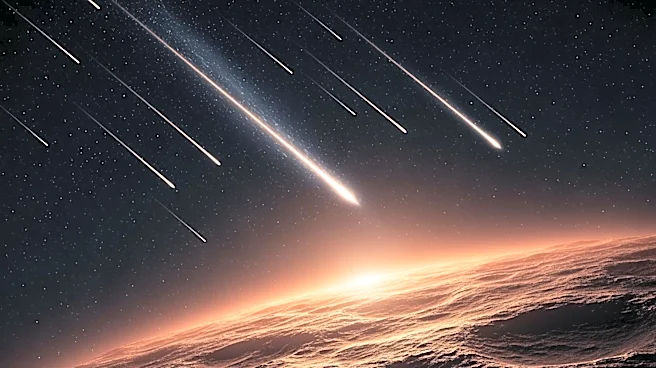
A NASA postdoctoral fellow in planetary sciences has discovered a new meteor shower originating from an asteroid that is disintegrating due to intense solar heat. The discovery was made by analyzing millions of meteor observations from all-sky camera
networks across Canada, Japan, California, and Europe. The study, published in March 2026, identified a cluster of 282 meteors linked to an asteroid that orbits extremely close to the sun. This proximity causes the asteroid's surface to crack and release gases, leading to its gradual disintegration. The meteors from this cluster are moderately fragile, indicating that the intense solar heat is a significant factor in their formation. This discovery provides insights into the physical evolution of asteroids and comets in the solar system and highlights the potential for meteor observations to reveal hidden populations of near-Earth asteroids.
Why It's Important?
The discovery of a new meteor shower from a sun-baked asteroid is significant for several reasons. It enhances our understanding of how asteroids and comets evolve over time, particularly those that come close to the sun. This knowledge is crucial for planetary defense, as it helps identify potentially hazardous asteroids that could pose a threat to Earth. Additionally, the study of meteors provides a unique method for detecting active asteroids that may not be visible through traditional telescopes. By understanding the processes that cause asteroids to disintegrate, scientists can better predict and mitigate the risks associated with near-Earth objects. This research also contributes to the broader field of planetary science by offering new insights into the dynamic interactions between celestial bodies and the sun.