








What's Happening?
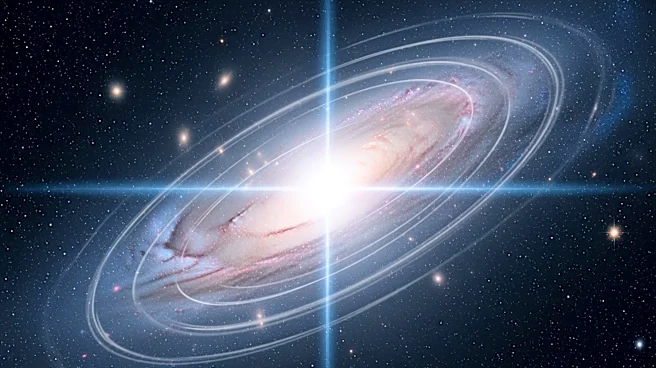
Researchers from Leiden University have conducted a study demonstrating how small changes in the position of a single star can lead to significant structural changes in a galaxy. Using computer simulations, Tetsuro Asano and Simon Portegies Zwart modeled
Milky Way-like galaxies and found that even minimal differences in initial conditions can result in divergent outcomes. This phenomenon, akin to the butterfly effect, challenges the traditional view that galaxies behave as smooth systems where small disturbances average out. The study highlights that galaxies can exhibit both chaotic and smooth behaviors, depending on the simulation parameters.
Why It's Important?
This research provides new insights into the chaotic nature of galaxies, which has implications for our understanding of cosmic evolution and the reliability of galaxy simulations. By identifying the conditions under which simulations accurately reflect real galaxies, scientists can improve models used to study galaxy formation and behavior. This could lead to more accurate predictions about the future evolution of galaxies, including our own Milky Way. The findings also resolve a longstanding paradox about the dual nature of galaxies, offering a clearer framework for future astronomical research.
What's Next?
The study suggests that further research is needed to explore the limits of chaos in galaxy simulations. By refining simulation techniques, astronomers can better understand the factors that influence galaxy behavior over time. This could involve developing new models that account for the chaotic interactions between stars and dark matter. Additionally, the findings may prompt a reevaluation of previous studies that assumed galaxies behave as smooth systems, potentially leading to new discoveries about the dynamics of the universe.