
What's Happening?
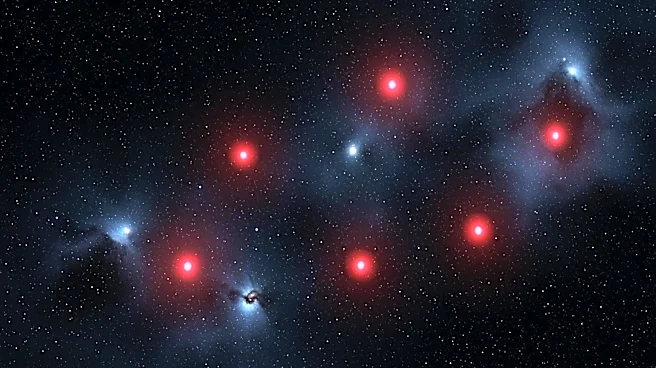
Astronomers using the James Webb Space Telescope (JWST) have potentially solved the mystery of 'little red dots' in the early universe. These objects, first observed when the JWST began sending data in 2022,
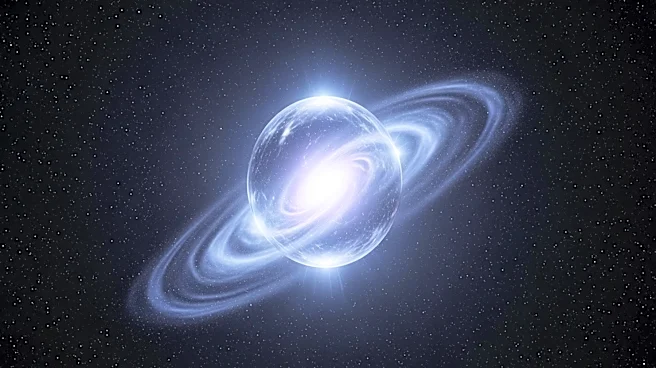
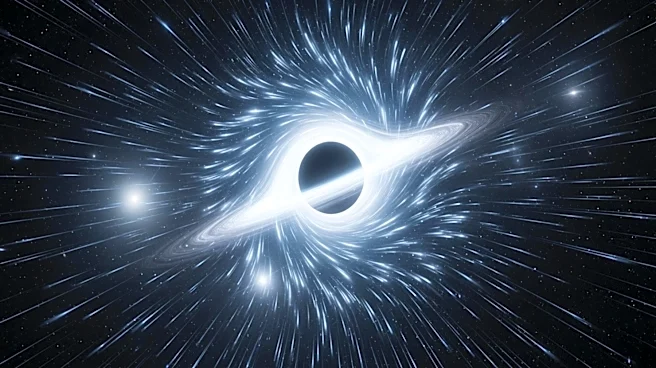
are believed to be black hole stars—supermassive black holes enveloped in dense gas clouds. The team studied GLIMPSE-17775, a 'little red dot' seen 1.8 billion years after the Big Bang, and found evidence supporting this theory. The discovery includes spectral lines from iron, dubbed an 'iron forest,' indicative of high-energy output from a rapidly feeding supermassive black hole. This finding could explain why these objects are faint in X-rays, as the dense gas cocoons absorb high-energy radiation.
Why It's Important?
This discovery is significant as it provides a potential explanation for the 'little red dots' that have puzzled scientists and challenged existing cosmological models. Understanding these objects could offer insights into the formation and evolution of the universe, particularly during its early stages. The identification of black hole stars could reshape theories about the growth of supermassive black holes and their role in galaxy formation. This research also highlights the capabilities of the JWST in exploring deep space phenomena, potentially leading to further breakthroughs in our understanding of the cosmos.
What's Next?
Future research will likely focus on gathering more observational evidence to confirm the existence of black hole stars and further explore their characteristics. Continued observations with the JWST and other telescopes could provide additional data to refine models of early universe phenomena. Scientists may also investigate the implications of these findings on the broader understanding of galaxy evolution and the lifecycle of supermassive black holes. The study of GLIMPSE-17775 and similar objects could lead to new questions and hypotheses about the universe's formative years.