
What's Happening?
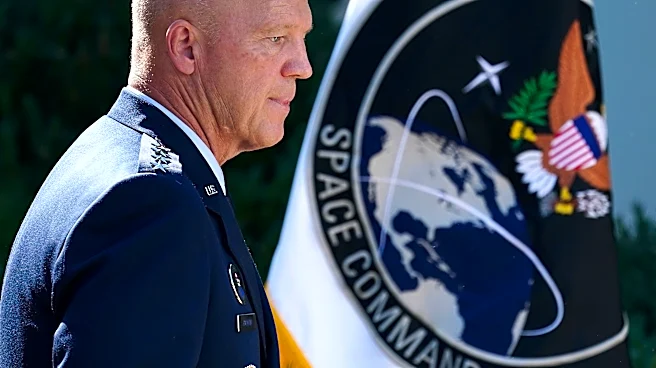
Secretary of the Air Force Troy Meink recently announced that the U.S. Space Force now possesses on-orbit space control weapons capable of defending joint forces against hostile adversary actions. This
development has intensified discussions regarding how the United States should utilize these capabilities. While the legality of such weapons is generally accepted under the law of armed conflict, the broader question revolves around establishing a cogent U.S. position that considers not only tactical military advantage but also holistic national interests and the future stability of the space domain. The law of armed conflict defines military objectives as objects making an effective contribution to military action whose destruction offers a definite military advantage. This framework applies to space objects, including commercial satellites, which could be deemed legitimate targets if they contribute to an adversary's military efforts.
Why It's Important?
The U.S. Space Force's acquisition of on-orbit space control weapons marks a significant evolution in military capabilities and strategy, transforming space into an active warfighting domain. This development necessitates a clear and comprehensive policy framework to guide their use, as any action in space could set precedents for future international conduct. The debate extends beyond legality to ethical considerations and long-term policy implications, particularly concerning the targeting of commercial satellites. Given the increasing reliance on commercial space assets for both civilian and military purposes, defining what constitutes a legitimate military objective in space is crucial. The U.S. position will influence international norms and potentially shape the future of space security, impacting commercial, civil, scientific, and national security interests globally.
What's Next?
The United States faces the immediate challenge of developing a clear and comprehensive policy on the use of its space weapons. This policy will need to balance military effectiveness with the desire for a stable and predictable space domain, considering the potential for escalation and the impact on commercial and civilian space activities. Discussions will likely involve senior policymakers, military leaders, and legal experts to define thresholds for engagement, rules of engagement, and the criteria for targeting various space assets, including commercial ones. The U.S. will also need to engage with allies and adversaries to shape international norms and understandings regarding space warfare, aiming to establish responsible behavior and accountability for violations. This ongoing dialogue will be critical in preventing a 'race to the bottom' in space and fostering a secure environment for all users.
Beyond the Headlines
The presence of on-orbit space control weapons introduces complex ethical and strategic dilemmas. The dual-use nature of many space technologies means that commercial satellites, while serving civilian purposes, can also provide critical support to military operations, blurring the lines of what constitutes a legitimate target. This ambiguity could lead to unintended escalation or widespread disruption of essential services that rely on space infrastructure. Furthermore, the development of such weapons could spur an arms race in space, increasing the risk of conflict and jeopardizing the long-term sustainability of space activities due to debris generation. The U.S. has an opportunity to lead in establishing responsible norms and practices, but this requires careful consideration of the broader geopolitical implications and a commitment to international cooperation to ensure space remains a domain for peaceful use and scientific advancement.