







What's Happening?
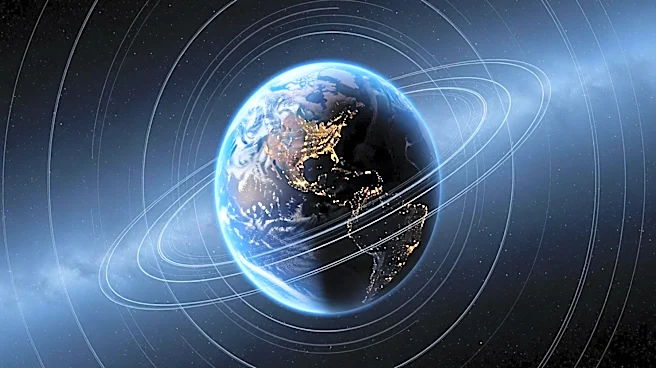
A recent study published in the Journal of Geophysical Research: Solid Earth has found that global warming is causing Earth's rotation to slow, resulting in longer days. The research indicates that the melting of ice in regions such as Greenland and Antarctica
is redistributing mass away from the poles, which in turn slows the planet's rotation. This phenomenon has been increasing the length of a day by approximately 1.33 milliseconds per century over the past 20 years. The study, led by researchers from Switzerland and Austria, suggests that this rate of slowdown is unprecedented in at least 3.6 million years. The findings also highlight the role of water movement in subtly reshaping Earth's motion, with previous studies noting that groundwater extraction has contributed to polar drift.
Why It's Important?
The implications of this study are significant for various technologies that rely on precise timing, such as GPS systems, navigation apps, and satellites. As Earth's rotation slows, these systems may require adjustments to maintain accuracy. The research underscores the broader impact of climate change beyond environmental and ecological effects, highlighting its influence on planetary dynamics. The study also adds to the growing body of evidence that human activities, such as groundwater extraction, are contributing to changes in Earth's physical properties. This could lead to further discussions on sustainable resource management and climate change mitigation strategies.