




What's Happening?
The U.S. Navy has exercised an $11.3 million option with Integer Technologies to continue developing software designed to map the underwater soundscape for submarines and undersea drones. This contract modification, P00002 to contract N0001426C2208, is part
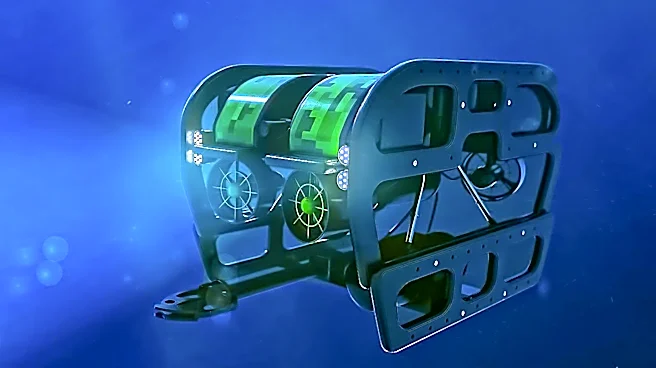
of an initiative called Operationalizing Marine Acoustics for Strategic Awareness. The work, managed by the Office of Naval Research, will be conducted in Durham, New Hampshire, and is expected to continue through October 2029. The research focuses on utilizing passive acoustic data—sounds already present in the ocean—to create decision support tools for undersea warfare, as well as seabed and subsea warfare. Integer Technologies is developing a framework that integrates physics-based models with super intelligence and machine learning. The Navy intends for these tools to be deployable on both crewed and uncrewed platforms, enabling them to automatically process and interpret acoustic data to adapt missions quickly without requiring specialist analysis.
Why It's Important?
This investment is critical for enhancing the U.S. Navy's capabilities in undersea warfare, where sound is the primary means of communication and detection. Understanding the underwater soundscape is akin to understanding terrain on land, allowing naval forces to optimize movement, communication, and sensing. The ability to map and interpret this soundscape in real-time provides a significant tactical advantage, enabling submarines and undersea drones to operate more effectively, avoid detection, and improve target acquisition. The integration of super intelligence and machine learning will automate complex data analysis, reducing the cognitive load on operators and allowing autonomous systems to make rapid, informed decisions. This technological advancement is particularly vital given growing concerns over threats to undersea cables and pipelines, as it supports the deployment of seabed warfare capabilities for survey and attribution, as highlighted by Vice Adm. Richard Seif, commander of U.S. Navy Submarine Forces.
What's Next?
Integer Technologies will proceed with the development of the software framework, focusing on combining physics-based models with advanced AI and machine learning techniques. The Office of Naval Research will continue to fund and oversee the project, with work progressing in Durham, New Hampshire, until October 2029. The Navy will likely conduct extensive testing of the developed tools on various crewed and uncrewed platforms to validate their effectiveness in diverse underwater environments. Future Virginia-class Block VI submarines are planned to incorporate organic seabed warfare capabilities, suggesting that the outputs of this research could be integrated into these advanced platforms. The success of this program could lead to further contracts for deployment and integration across the fleet, potentially influencing the design and operational doctrines of future undersea warfare assets.
Beyond the Headlines
The development of advanced undersea soundscape mapping represents a significant leap in naval intelligence and operational autonomy. By enabling platforms to understand their acoustic environment in real-time, the Navy is moving towards a more adaptive and intelligent undersea force. This initiative also underscores the increasing importance of uncrewed systems in modern naval strategy, as these tools are designed to enhance the capabilities of both crewed and uncrewed platforms. The concept of 'super intelligence' being applied to marine acoustics suggests a future where AI plays a more central role in complex decision-making processes in challenging environments. Ethically, the enhanced surveillance and operational capabilities raise questions about the future of undersea domain awareness and potential implications for international maritime law and freedom of navigation. This technological push could also spur further innovation in acoustic sensing and processing across the defense industry.