
What's Happening?
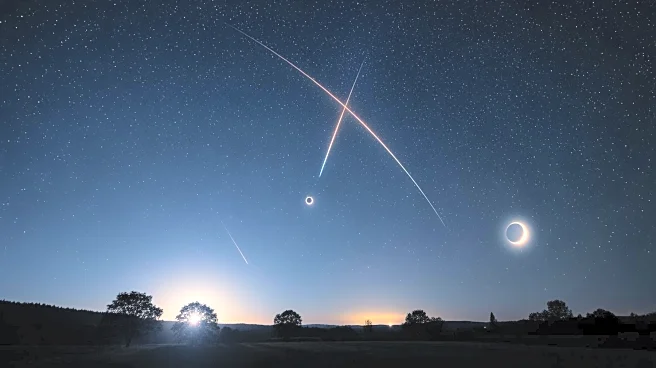
The year 2026 is set to feature a series of remarkable astronomical events, including meteor showers, a total solar eclipse, and a total lunar eclipse. The Quadrantid meteor shower will kick off the year on January
3-4, although its visibility may be affected by the full moon. A total lunar eclipse will occur on March 3, visible across North America, with the East Coast experiencing moonset during totality. The West Coast will have a full view of the eclipse, which lasts 58 minutes. On August 12, a total solar eclipse will be visible in parts of eastern Greenland, western Iceland, and Spain. The Perseid meteor shower will follow on August 12-13, offering optimal viewing conditions due to the new moon. The year will conclude with the Geminid meteor shower on December 13-14, known for its visually striking meteors.
Why It's Important?
These astronomical events provide unique opportunities for scientific observation and public engagement with space phenomena. Meteor showers and eclipses can offer insights into atmospheric conditions and celestial mechanics. The total lunar eclipse, for instance, can help scientists assess atmospheric pollution levels using the Danjon Scale. The solar eclipse presents a rare chance for eclipse chasers and researchers to study the sun's corona. Public interest in these events can foster greater appreciation for astronomy and encourage educational activities. Additionally, these events can boost tourism in regions where visibility is optimal, as enthusiasts travel to witness these celestial spectacles.
What's Next?
As these events approach, preparations for public viewing and scientific study will intensify. Observatories and educational institutions may organize events to facilitate public engagement and provide educational resources. Regions within the path of the solar eclipse may experience increased tourism, prompting local authorities to plan for visitor accommodations and safety measures. Scientists will likely coordinate efforts to gather data during these events, particularly the eclipses, to advance understanding of atmospheric and solar phenomena. Public awareness campaigns may be launched to inform people about the best viewing practices and safety precautions.
Beyond the Headlines
Beyond the immediate spectacle, these astronomical events can inspire long-term interest in space exploration and science. They serve as reminders of the vastness and complexity of the universe, potentially motivating future generations to pursue careers in astronomy and related fields. The cultural significance of these events can also be profound, as they often bring communities together in shared experiences of wonder and curiosity. Moreover, the study of these events contributes to broader scientific knowledge, enhancing our understanding of Earth's place in the cosmos and the dynamics of celestial bodies.