



What's Happening?
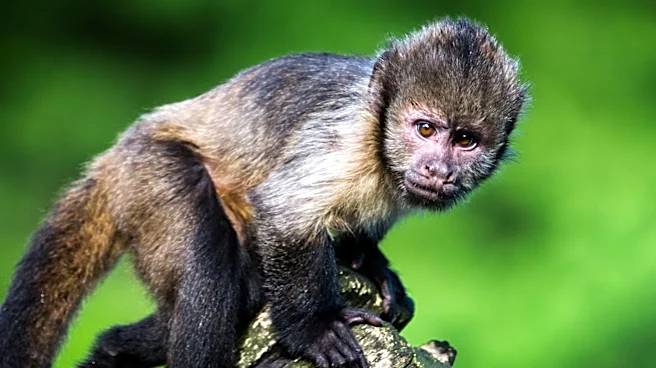
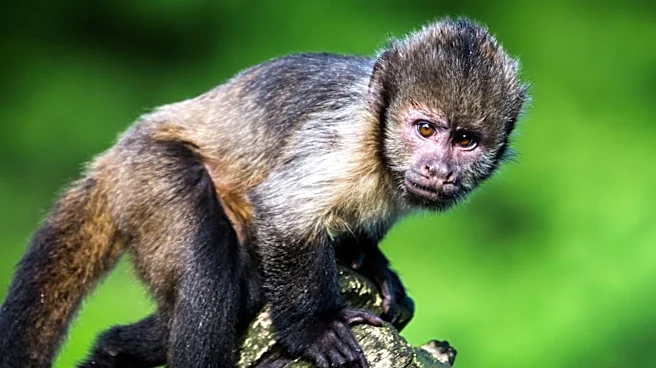
Scientists in Costa Rica have conducted an innovative experiment by placing an AI touchscreen in a wild forest, which was used by 16 capuchin monkeys. The system, known as CapuchinAI, identifies individual monkeys and presents them with learning tasks
on a touchscreen, rewarding them with banana slices for correct responses. This experiment, conducted by researchers from Emory University and Georgia Institute of Technology, aims to study the cognitive abilities of wild primates in their natural environment. The system successfully identified individual capuchins with 97% accuracy and demonstrated the potential for scalable cognitive testing in the wild.
Why It's Important?
This experiment represents a significant advancement in the study of primate cognition, providing a new method to evaluate and monitor cognitive abilities in natural settings. By integrating AI technology, researchers can gain deeper insights into the cognitive processes of primates, which can inform our understanding of human evolution and cognitive development. The ability to conduct such studies in the wild offers a more accurate representation of primate behavior and cognition, potentially leading to breakthroughs in anthropology, psychology, and evolutionary biology.
What's Next?
The research team plans to expand the facial-recognition model to include more capuchins and develop cognitive experiments across various domains. This will allow for a more comprehensive understanding of individual cognitive abilities and their relationship to environmental factors. The success of this project could pave the way for similar studies in other wildlife populations, enhancing our understanding of animal cognition and behavior in natural habitats.