






What's Happening?
Recent research conducted by Curtin University has shed light on the transportation of Stonehenge's Altar Stone, a six-tonne sandstone megalith, believed to have originated from northeast Scotland. The study suggests that the stone was moved over 700
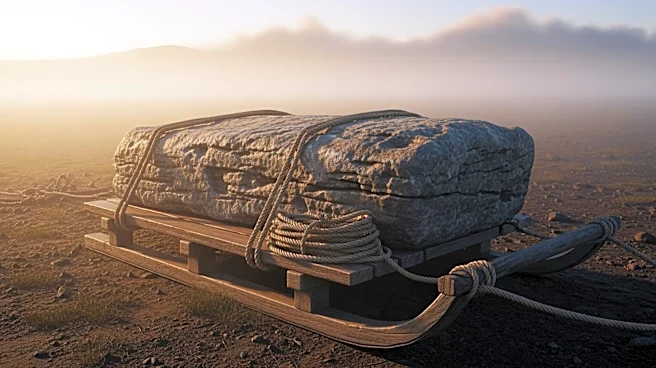
kilometers to its current location on Salisbury Plain, challenging previous theories that glaciers were solely responsible for its movement. The research utilized mineral grain dating and ice-sheet modeling to determine the stone's origin and potential transport routes. Findings indicate that while glaciers may have moved the stone partway, human intervention was necessary to complete the journey. This involved a combination of overland hauling and possibly river or coastal transport, requiring significant planning and coordination by Neolithic communities.
Why It's Important?
The study highlights the advanced organizational skills and cooperation among ancient communities, suggesting a level of societal complexity not previously fully appreciated. Understanding the human effort involved in transporting such massive stones provides insight into the capabilities and ingenuity of prehistoric societies. This research not only challenges existing theories about Stonehenge's construction but also contributes to the broader understanding of human history and prehistoric engineering. The findings could influence future archaeological studies and methodologies, emphasizing the importance of human agency in historical developments.
What's Next?
Future research aims to pinpoint the exact source of the Altar Stone in northeast Scotland and further explore the transport routes used by prehistoric communities. This could involve more detailed geological analysis and computer modeling to refine the understanding of the stone's journey. The study's findings may prompt additional investigations into other megalithic structures and their construction methods, potentially leading to new discoveries about ancient human societies and their interactions with the environment.