


What's Happening?
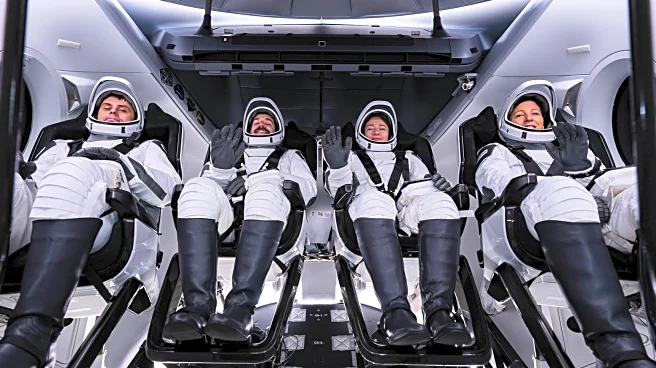
SpaceX successfully launched four crew members to the International Space Station (ISS) on February 13, 2026, following a delay in NASA's Artemis II moon mission. The Crew Dragon capsule, carrying Crew 12 commander Jessica Meir, pilot Jack Hathaway, European
Space Agency astronaut Sophie Adenot, and Russian cosmonaut Andrey Fedyaev, lifted off from Cape Canaveral Space Force Station. This mission aims to replace the previous crew who returned early due to a medical issue. The launch was initially scheduled after the Artemis II mission but was moved up due to delays caused by hydrogen fuel leaks in the Space Launch System rocket. The Crew 12 team is set to join the current ISS crew, boosting the station's staff back to seven members.
Why It's Important?
The successful launch of Crew 12 is crucial for maintaining operations and research at the ISS, which had been limited due to the early return of the previous crew. The presence of a full crew allows for the continuation of scientific experiments and ensures the station's systems are adequately managed. This mission highlights SpaceX's role in supporting NASA's objectives, especially during times of technical setbacks. The collaboration between international astronauts underscores the global nature of space exploration and the importance of maintaining a robust presence in orbit.
What's Next?
Crew 12 will conduct various scientific experiments during their eight-month stay, including studies on bone and muscle health, blood flow, and the effects of microgravity on vision. They will also test new exercise equipment and landing simulator software for future moon and Mars missions. The crew's activities will contribute to ongoing research that aims to improve astronaut health and mission success in long-duration spaceflights. Additionally, the crew plans to engage in cultural activities, such as playing musical instruments, to enhance their experience aboard the ISS.
Beyond the Headlines
The launch of Crew 12 not only addresses immediate operational needs at the ISS but also reflects broader trends in space exploration, such as the increasing involvement of private companies like SpaceX. This mission exemplifies the shift towards international cooperation in space, with astronauts from different countries working together. The inclusion of diverse backgrounds and expertise among the crew members highlights the evolving nature of astronaut selection and training, which now emphasizes a wide range of skills beyond traditional aerospace qualifications.