




What's Happening?
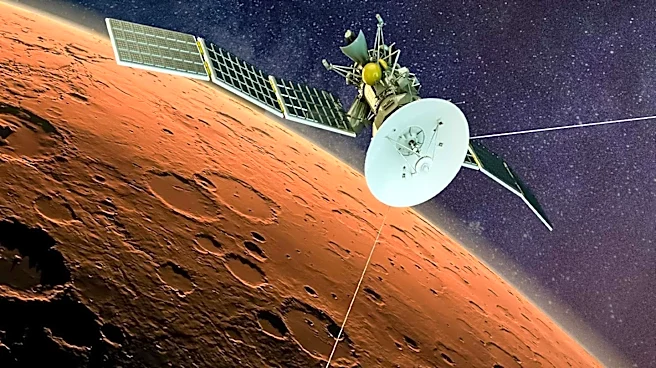
NASA's Psyche spacecraft, en route to the asteroid belt, captured rare images of Mars during a flyby in May. The spacecraft utilized Mars' gravity to gain speed for its journey to the asteroid Psyche. During this maneuver, the spacecraft's imaging team
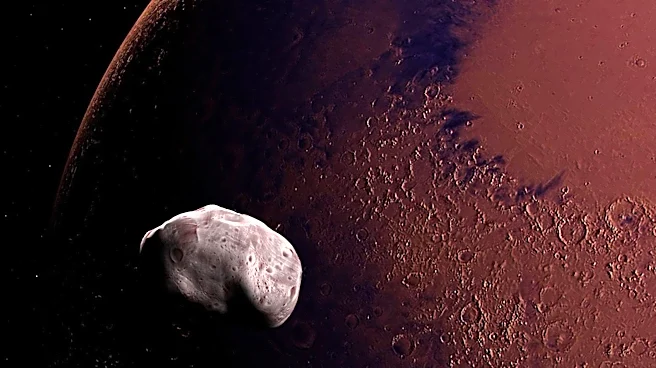
captured a series of time-lapse images, revealing Mars' atmosphere glowing in a crescent shape. The images, taken from May 2 to May 31, were released as a time-lapse video, providing a unique view of the planet. The mission's instruments, including the imager, magnetometer, and gamma-ray and neutron spectrometer, collected valuable data, although no new discoveries were anticipated due to Mars' extensively studied surface.
Why It's Important?
The images and data from Psyche's flyby of Mars offer new insights into the planet's atmospheric conditions and surface features. This mission highlights the potential for spacecraft to gather valuable scientific data during gravity assist maneuvers. The successful operation of Psyche's instruments during the flyby also serves as a test for future observations at its primary destination, the asteroid Psyche. The mission's findings contribute to a better understanding of Mars and demonstrate the capabilities of NASA's spacecraft in capturing detailed planetary imagery.
What's Next?
Psyche is expected to reach its primary target, the asteroid Psyche, in August 2029. The mission will continue to provide valuable data on the asteroid's composition and structure, which could offer insights into the early solar system and the formation of planetary cores. The success of the Mars flyby sets a positive precedent for the mission's future observations and data collection efforts.