









What's Happening?
A proposal to launch over a million satellites into low Earth orbit has raised significant concerns among astronomers. Companies such as SpaceX, Starcloud, Cowboy Space, Orbital Compute, and Blue Origin have filed applications with the U.S. Federal Communications
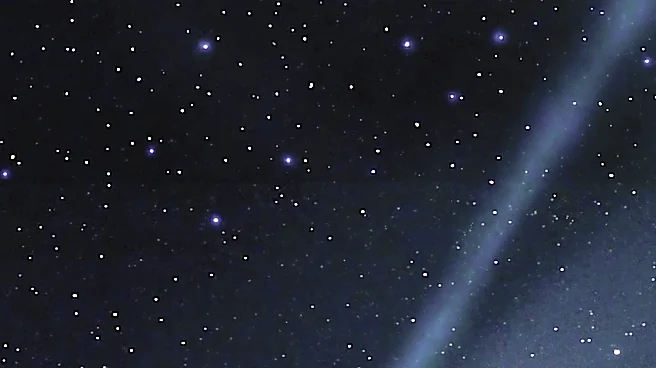
Commission (FCC) to deploy these satellites, which are intended for data storage. Additionally, tens of thousands of orbital mirrors are planned to reflect sunlight to Earth after dark. This initiative could create a bright band around the planet, akin to Saturn's rings, visible from anywhere on Earth. Reflect Orbital, a California-based company, has already received FCC approval to launch its first demonstration mirror, Eärendil-1, by the end of the year. Astronomers fear that this could severely impact observational astronomy, as the satellites would form a single, tightly packed orbital path, outshining and outnumbering visible stars.
Why It's Important?
The proposed satellite ring poses a significant threat to space science and observational astronomy. The bright band created by these satellites could compromise the effectiveness of telescopes, making it difficult to conduct scientific research, including the search for near-Earth asteroids. The American Astronomical Society (AAS) has expressed concerns about potential damage to research equipment and the risk of flash-blinding pilots and drivers. The project could also lead to permanent eye damage for individuals using mid-sized telescopes. The FCC's decision to approve Reflect Orbital's project, despite these concerns, highlights a regulatory gap in protecting optical astronomy. The initiative could fundamentally alter the night sky, impacting both scientific research and the general public's ability to observe the stars.
What's Next?
Reflect Orbital plans to proceed with its project, having received FCC approval. The AAS has urged the FCC to reconsider the potential impacts on Earth and the long-term effects of such a satellite network. As the project moves forward, there may be increased advocacy from the scientific community to address the regulatory gaps and protect the night sky. The outcome of this initiative could set a precedent for future satellite deployments and their regulation. Stakeholders, including astronomers and environmental groups, may push for international cooperation to mitigate the impact on space science and preserve the natural night sky.