







What's Happening?
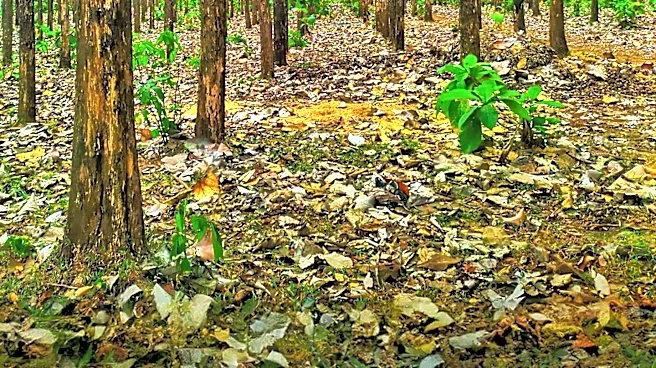
China's ambitious reforestation project, known as the Great Green Wall, has seen the planting of 66 billion trees over the past five decades across the Gobi and Taklamakan deserts. This initiative, which began in 1978 and is expected to be completed by
2050, aims to combat desertification by slowing the spread of the deserts into China's grasslands. Recent studies have revealed that the trees in this artificial forest are growing faster than those in natural forests, potentially due to their response to rising atmospheric CO2 levels. However, questions remain about the long-term effectiveness of these planted forests in carbon sequestration compared to natural forests.
Why It's Important?
The Great Green Wall project is significant as it represents one of the largest reforestation efforts globally, with implications for climate change mitigation and environmental policy. The faster growth rate of the planted forests suggests they could be a powerful tool for short-term carbon uptake. However, the study highlights that natural forests may be more effective for long-term carbon storage and ecological resilience. This finding could influence future reforestation strategies and policies, emphasizing the need for a balanced approach that incorporates both planted and natural forests to maximize environmental benefits.
What's Next?
As the Great Green Wall project progresses, further research is needed to understand the ecological dynamics of planted versus natural forests. Policymakers and environmental scientists may need to adjust strategies to ensure the long-term sustainability and effectiveness of reforestation efforts. This could involve integrating more natural forest management practices and diversifying tree species to enhance resilience against climate change. Additionally, the project's outcomes could inform global reforestation initiatives, providing valuable insights into the best practices for combating desertification and enhancing carbon sequestration.
Beyond the Headlines
The Great Green Wall project also raises ethical and cultural considerations, particularly regarding the displacement of local communities and the alteration of natural landscapes. The initiative's success depends not only on ecological factors but also on social acceptance and the involvement of local populations in conservation efforts. Furthermore, the project underscores the importance of international collaboration in addressing global environmental challenges, as lessons learned from China's experience could benefit other regions facing similar issues.