






What's Happening?
Europe and India have officially renewed their strategic space partnership through 2032, aiming to collaboratively address critical challenges in human spaceflight tracking, solar weather hazards, and orbital security. This extended cooperation agreement
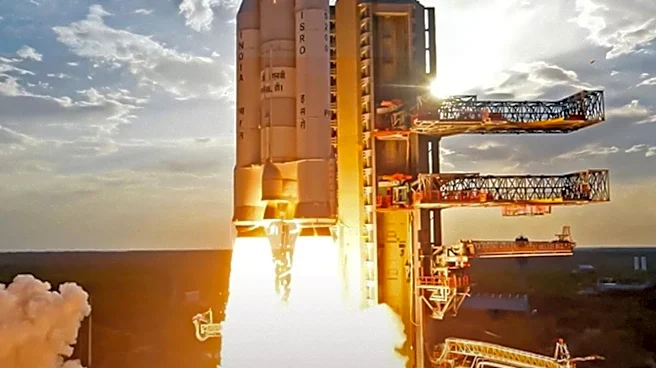
between the European Space Agency (ESA) and the Indian Space Research Organisation (ISRO) builds upon a decades-long relationship that began with a formal framework in January 2002. The renewed agreement broadens the scope of their collaboration to include new priorities in the evolving global space sector. A significant focus is placed on both human and robotic space exploration, with the European network providing vital ground station support for India's upcoming Gaganyaan human spaceflight program. This support will involve antennas in Kourou, coordinated by control centers in Germany, to track and monitor the Indian crew module. Additionally, the partnership will enhance space weather monitoring to protect orbital technology and terrestrial infrastructure from severe solar events, and commit to sustainable space use by aligning technical practices to reduce orbital debris and improve safety guidelines.
Why It's Important?
This extended partnership between two major spacefaring entities has significant implications for global space governance and the U.S. space industry. Increased international cooperation in areas like human spaceflight tracking and orbital security contributes to a safer and more predictable space environment, which benefits all nations with assets in orbit, including the U.S. The collaborative efforts to monitor solar weather hazards are crucial for protecting critical infrastructure, such as satellite communications, navigation systems, and power grids, which are essential for U.S. economic and national security. Furthermore, the commitment to reducing orbital debris and improving safety guidelines aligns with U.S. efforts to promote space sustainability. This partnership could also foster the development of common standards and technologies, potentially creating new opportunities or challenges for U.S. space companies and research institutions.
What's Next?
The renewed agreement will see continued collaboration on Earth observation, satellite navigation, and space science, with an additional focus on satellite calibration and validation. The European network will provide essential deep-space tracking for Indian missions, building on past successes like the Chandrayaan-3 lunar lander and the Aditya-L1 solar observatory. The partnership will actively support ambitious crewed flights, with ESA's Estrack network providing ground station support for India's Gaganyaan human spaceflight program. Both agencies will also work on sharing data to build better forecasting models for solar weather and align technical practices to reduce orbital debris. This ongoing collaboration is expected to drive scientific progress and ensure the sustainable use of outer space.
Beyond the Headlines
The deepening of the India-Europe space partnership reflects a growing trend towards multilateralism in space exploration and governance. As space activities become more complex and congested, no single nation can effectively address all challenges alone. This collaboration highlights the recognition that shared challenges, such as space debris and solar weather, require shared solutions. The emphasis on human spaceflight and deep-space exploration also signals a long-term vision for expanding humanity's presence beyond Earth. This partnership could serve as a model for other international collaborations, influencing the future landscape of space policy, technology development, and scientific discovery, and potentially shaping the competitive and cooperative dynamics within the global space industry.