







What's Happening?
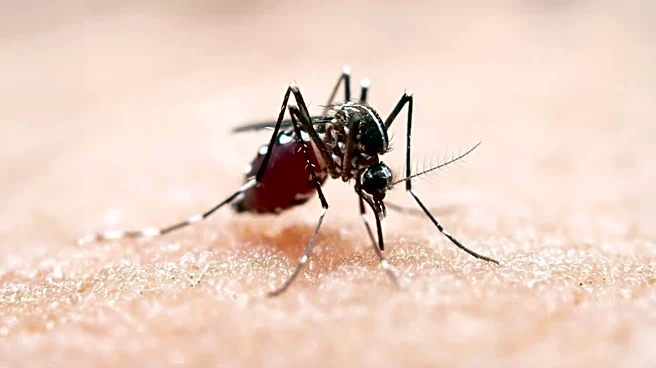
A recent study conducted by a team from IRD, CNRS, the University of Montpellier (France), and Mahidol University (Thailand) has revealed that mosquito saliva actively aids in establishing infections of viruses like Zika, Dengue, and West Nile. Published
in Nature Communications, the research identified a viral compound, sfRNA (subgenomic flavivirus RNA), present in the saliva of infected mosquitoes. This sfRNA appears to promote infection by inhibiting the body's initial immune response, allowing viruses to gain a foothold at the bite site. The study utilized an in vivo transmission model and found that a higher amount of sfRNA in saliva correlated with stronger infection promotion. This mechanism was observed in both West Nile virus, transmitted by Culex mosquitoes, and Zika virus, transmitted by Aedes mosquitoes, suggesting a common strategy among orthoflaviviruses. This discovery opens avenues for a new vaccination approach targeting this shared mechanism.
Why It's Important?
This research holds significant importance for global public health, particularly in tropical and subtropical regions where mosquito-borne diseases are prevalent. Dengue, Zika, and West Nile viruses collectively account for approximately 500 million infections annually, yet effective treatments covering all these diseases are lacking. Understanding how mosquito saliva influences skin infection is crucial for developing better transmission prevention strategies. The identification of sfRNA as a key factor in suppressing the innate immune response provides a novel target for intervention. By focusing on this common viral compound in mosquito saliva, rather than individual viruses, a single vaccination strategy could potentially offer protection against multiple orthoflaviviruses. This could lead to a more efficient and widespread approach to combating these debilitating diseases, reducing the burden on healthcare systems and improving quality of life in affected areas.
What's Next?
Building on this discovery, researchers at IRD are actively developing and optimizing a vaccination strategy that targets the identified salivary compound, sfRNA. This approach is being advanced for clinical-scale application as part of the Horizon Europe Flavivaccine project. The project aims to explore a prevention strategy against several endemic diseases affecting countries in the Global South. The next steps will likely involve further preclinical testing, followed by human clinical trials to assess the safety and efficacy of this novel vaccine. If successful, this could lead to the development of a broad-spectrum vaccine capable of protecting against multiple mosquito-borne viral infections, potentially transforming public health efforts in regions heavily impacted by these diseases.
Beyond the Headlines
The deeper implications of this research extend beyond immediate vaccine development. The finding that a viral compound in mosquito saliva can actively manipulate the host's immune system highlights the complex co-evolutionary strategies employed by pathogens and their vectors. This understanding could inform future research into other vector-borne diseases, potentially revealing similar immune-modulating mechanisms that could be targeted. Furthermore, the emphasis on a common mechanism across multiple viruses underscores a shift towards more generalized, platform-based approaches in vaccine development, moving away from single-pathogen specific interventions. This could accelerate the development of countermeasures against emerging infectious diseases and enhance preparedness for future pandemics, particularly those transmitted by arthropod vectors.