








What's Happening?
President Trump's recent criticisms of Italy's Premier Giorgia Meloni have inadvertently led to a strengthening of ties among European leaders. Trump questioned Italy's reliability as a wartime ally and accused Meloni of seeking his attention, which prompted
European leaders to rally around Meloni. This development has helped thaw previously frosty relations due to Meloni's hard-right political roots. European leaders are increasingly coordinating on defense, tariffs, and foreign policy in response to global challenges such as the wars in Ukraine and Iran, and economic pressures from China and Russia. This unity is seen as necessary to maintain Europe's global standing, especially as Trump has often preferred bilateral negotiations with European countries.
Why It's Important?
The unity among European leaders in response to President Trump's actions highlights a significant shift in international relations. By rallying around Meloni, European leaders are demonstrating a collective front against external pressures, which could lead to more cohesive policies on defense and foreign affairs. This development reduces Trump's ability to negotiate with European countries individually, potentially altering the dynamics of U.S.-Europe relations. The situation underscores the importance of European unity in maintaining geopolitical stability and addressing global challenges. It also reflects the broader ideological battles within Europe, as nationalist parties adjust their stances in response to Trump's policies, which are increasingly unpopular with voters.
What's Next?
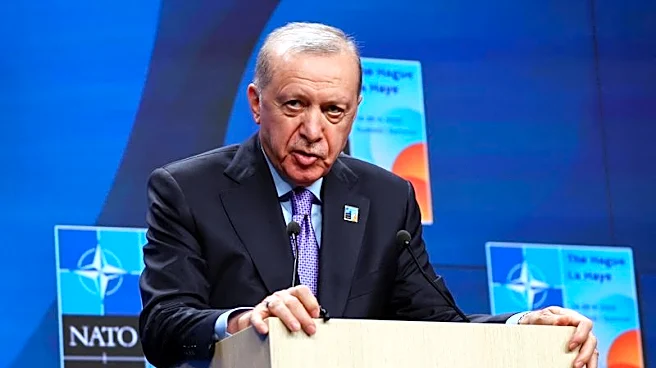
The newfound European unity will be tested at the upcoming NATO summit in Turkey, where leaders will need to navigate complex geopolitical issues. The continued coordination among European countries could lead to more unified policies on defense and foreign affairs, potentially impacting U.S. influence in the region. As elections approach in various European countries, domestic issues may take precedence, influencing how leaders engage with the U.S. and other global powers. The situation also poses political risks for leaders closely aligned with Trump, as seen in Hungary, where support for Trump did not prevent a political shift.
Beyond the Headlines
The situation highlights the broader implications of U.S. foreign policy on international alliances. European leaders' response to Trump's criticism of Meloni reflects a strategic recalibration to protect European interests. This shift could lead to long-term changes in how Europe engages with global powers, emphasizing the importance of multilateral cooperation. The dynamics also illustrate the potential political costs of aligning too closely with controversial figures, as domestic electorates may hold leaders accountable for international associations. The evolving relationship between Europe and the U.S. could influence future diplomatic and economic interactions.