










What's Happening?
The Democratic Republic of Congo is experiencing a significant expansion of its Ebola outbreak, with new suspected cases emerging in provinces that were previously unaffected. According to the Congolese health ministry, the death toll from the outbreak has
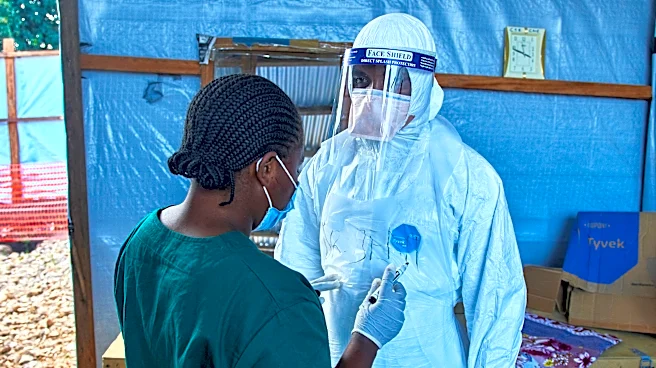
reached 600. The provinces of Tshopo and Haut-Uele have reported new suspected cases, indicating the virus's spread beyond its initial epicenter in Ituri. A government report highlighted two new suspected cases in Kisangani, Tshopo province, with one linked to the Nia-Nia health zone in Ituri, while the other has no apparent connection to known outbreaks. The outbreak, declared on May 15, is attributed to the Bundibugyo virus, which lacks an approved vaccine or treatment. Efforts to contain the virus are challenged by a funding gap, attacks on health centers, and ongoing conflict in eastern Congo.
Why It's Important?
The expansion of the Ebola outbreak in Congo poses significant public health challenges, not only for the country but potentially for the broader region. The spread to new provinces suggests difficulties in containing the virus, which could lead to further transmission. The lack of an approved vaccine or treatment for the Bundibugyo virus complicates response efforts. Additionally, the outbreak's impact is exacerbated by the region's instability, including attacks on health centers and ongoing conflict, which hinder effective healthcare delivery. The situation underscores the need for international support and resources to manage the outbreak and prevent a larger health crisis.
What's Next?
Authorities in Congo are likely to intensify their efforts to trace and contain the virus, particularly in newly affected areas. The ongoing clinical trials for treatment may offer some hope, but the immediate focus will be on preventing further spread. International health organizations, including the World Health Organization, may increase their involvement to provide support and resources. The situation may also prompt neighboring countries to enhance their surveillance and preparedness measures to prevent cross-border transmission.