





What's Happening?
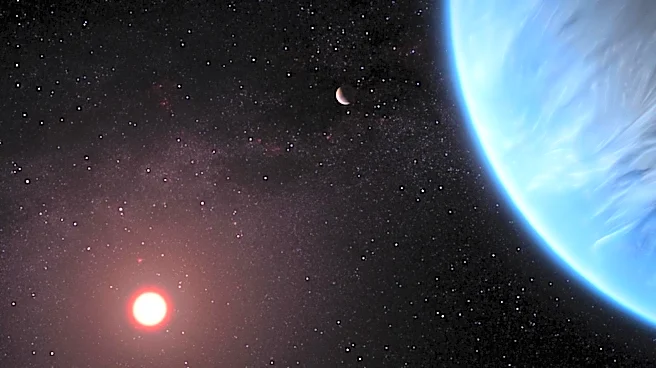
Recent observations of the exoplanet LHS 1140b have detected helium escaping from its atmosphere, a significant development in the study of planets beyond our Solar System. This exoplanet, orbiting a dim red star in the constellation Cetus, is of particular
interest because it is a potentially rocky world located within its star's 'habitable zone,' meaning surface temperatures could allow for liquid water. Previous observations with the James Webb Space Telescope had ruled out a hydrogen-rich 'primary' atmosphere, which typically dissipates early in a planet's life. The detection of helium now suggests the presence of a 'secondary' atmosphere, which is considered more stable and long-lived. On Earth, a secondary atmosphere has persisted for billions of years, with its chemical balance influenced by geology, chemistry, and life. While the detection of helium is a step forward, the exact nature of LHS 1140b's atmosphere and its potential for life remains uncertain, with calculations of surface conditions involving significant, untested assumptions. A second observation of the planet did not detect helium, leaving the reasons for this discrepancy unclear.
Why It's Important?
The potential presence of a stable secondary atmosphere on LHS 1140b is crucial for understanding exoplanet habitability. Primary atmospheres, composed mainly of hydrogen, are often lost early in a planet's formation. A secondary atmosphere, however, can persist for much longer, providing the conditions necessary for the development and sustenance of life. The chemical composition of such an atmosphere can offer clues about geological processes, the presence of liquid water, and even potential biosignatures. If LHS 1140b indeed possesses a long-lived atmosphere, it significantly increases its candidacy as a world where life could exist, making it a prime target for future, more detailed atmospheric spectroscopy. The challenge in characterizing 'super-Earths' or 'mini-Neptunes' like LHS 1140b highlights a gap in our understanding of planetary physics, especially since these types of planets are believed to be the most common in the Universe. Confirming the existence and composition of secondary atmospheres on such worlds is vital for refining models of planetary evolution and the search for extraterrestrial life.
What's Next?
The scientific community will likely focus on further observations and advanced atmospheric spectroscopy of LHS 1140b to confirm the presence and composition of its secondary atmosphere. Resolving the discrepancy between the initial helium detection and the subsequent non-detection will be a key priority, potentially requiring more sensitive instruments or longer observation periods. Researchers will also continue to refine mathematical models to more accurately determine the surface conditions of LHS 1140b, moving beyond current assumptions. The broader goal is to observe the atmospheres of thousands of exoplanets to establish general rules for how planetary atmospheres function. This extensive data collection will be critical for identifying potentially biogenic molecules that could serve as unequivocal evidence of life. The ongoing journey to characterize exoplanet atmospheres will involve a concerted effort from astronomers and planetary scientists to develop new observational techniques and analytical tools.
Beyond the Headlines
The study of exoplanet atmospheres, particularly the search for secondary atmospheres, delves into fundamental questions about the origins and prevalence of life in the universe. The case of LHS 1140b underscores the complexity of defining 'habitability' and the limitations of current observational capabilities. The ambiguity surrounding the helium detection highlights the challenges inherent in cutting-edge astronomical research, where faint and ambiguous signals require rigorous verification and interpretation. This research also has implications for our understanding of Earth's own atmospheric evolution, as comparing our planet's history with that of exoplanets can provide insights into the unique conditions that allowed life to flourish here. The ongoing quest to characterize exoplanets pushes the boundaries of technology and scientific inquiry, fostering innovation in telescope design, data analysis, and theoretical modeling, ultimately reshaping our cosmic perspective and our place within it.