


What's Happening?
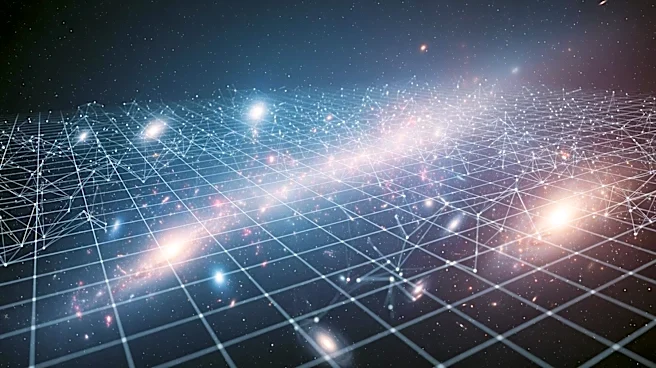
The Dark Energy Spectroscopic Instrument (DESI) has created the largest-ever 3D map of the universe, showcasing 47 million galaxies. This map, developed over five years, provides a detailed view of the universe's large-scale structure, including the cosmic
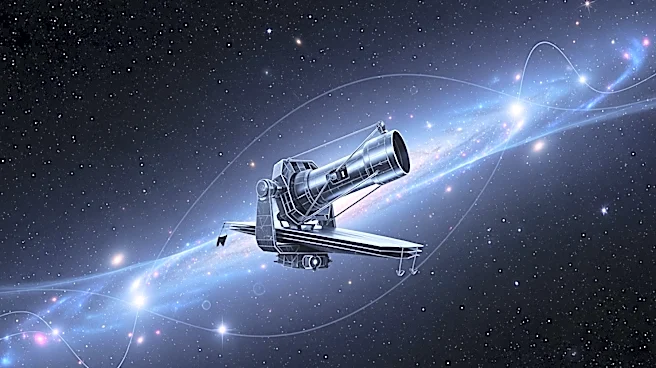
web of galaxies and voids. DESI, located at the Kitt Peak National Observatory in Arizona, uses advanced fiber-optic sensors to capture light from distant celestial objects. The map not only illustrates the distribution of galaxies but also offers insights into the universe's evolution and the role of dark energy.
Why It's Important?
This groundbreaking 3D map is crucial for understanding the universe's structure and the mysterious dark energy that drives its expansion. By analyzing the distribution of galaxies over time, scientists can gain insights into how dark energy influences cosmic evolution. This research could lead to significant breakthroughs in physics, potentially reshaping our understanding of the universe's past and future. The project, involving over 900 researchers from 70 institutions, underscores the importance of international collaboration in advancing scientific knowledge.
What's Next?
DESI will continue its observations until 2028, aiming to expand the map by 20%. Future efforts will focus on fainter and more distant galaxies, as well as challenging regions near the Milky Way. The first comprehensive results from the full dataset are expected in 2027, which could provide further insights into dark energy and the universe's structure. These findings may influence future research directions and theoretical models in cosmology.