






What's Happening?
Joshua Tree National Park, located in southern California, is a significant natural preserve spanning parts of the Mojave and Colorado Deserts. Established as a national monument in 1936 and later redesignated as a national park in 1994, it is renowned
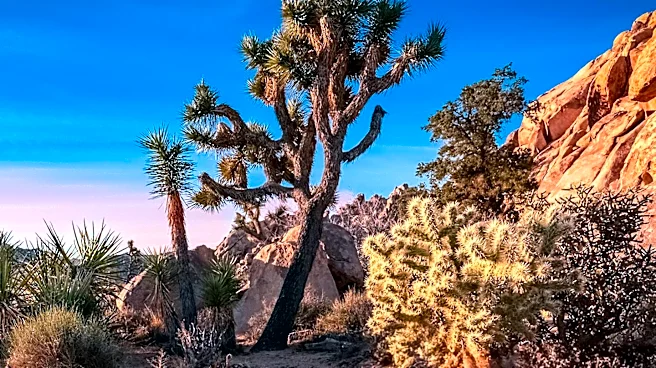
for its distinctive landscape. The park features the iconic twisted Joshua trees, which are a type of yucca, alongside jumbled granite boulders and expansive sandy basins. The higher elevations within the park are part of the Mojave Desert, where Joshua trees thrive, while the lower Colorado Desert sections are characterized by sparser shrubs and open plains. Geologically, the park showcases nearly two billion years of Earth's history, with ancient crystalline basement rocks and younger plutonic bodies. Its striking granite formations, including large, rounded boulder piles, are the result of monzogranite crystallizing beneath the surface over 100 million years ago, subsequently exposed and shaped by erosion. The park's diverse terrain includes mountain ranges, broad basins, and elevations reaching up to 1,773 meters (5,814 ft) at Quail Mountain, offering a wide range of desert environments.
Why It's Important?
Joshua Tree National Park holds significant importance as a protected area that conserves unique desert ecosystems and geological features. Its designation as a national park ensures the preservation of a landscape where two distinct desert regions, the Mojave and Colorado, converge, supporting a diverse array of plant and animal life adapted to limited rainfall, high solar exposure, and extreme temperature variations. The park's geological history, spanning nearly two billion years, provides invaluable insights into Earth's processes, with its granite formations serving as a natural laboratory for studying erosion and rock weathering. Beyond its ecological and geological value, the park offers substantial recreational and educational opportunities, attracting visitors for activities such as rock climbing, photography, and stargazing. Its dark night skies, far from urban light pollution, are particularly important for astronomy enthusiasts and contribute to the park's appeal as a natural wonder. The park's accessibility from major Southern California cities also makes it a crucial natural escape for urban populations, promoting environmental awareness and appreciation.
What's Next?
Visitors to Joshua Tree National Park can expect continued opportunities for exploration and engagement with its unique desert environment. The park will likely continue to focus on managing visitor impact to preserve its delicate ecosystems and geological formations, especially given its popularity for activities like rock climbing and stargazing. Efforts will also be directed towards maintaining and expanding infrastructure for visitor services, including roads, trails, and information centers, while ensuring minimal disruption to the natural landscape. Conservation initiatives will remain a priority, particularly concerning the iconic Joshua trees and the diverse wildlife that inhabits the park, which are vulnerable to climate shifts and human activity. Educational programs will likely be enhanced to inform visitors about the park's ecological significance, geological history, and the importance of responsible tourism. Furthermore, the park's role as a dark sky preserve will continue to be emphasized, potentially leading to more astronomy-focused events and facilities to cater to stargazers.
Beyond the Headlines
The preservation of Joshua Tree National Park extends beyond its immediate ecological and recreational benefits, touching upon broader themes of environmental stewardship and the human connection to nature. The park serves as a critical benchmark for understanding the impacts of climate change on arid environments, with the Joshua trees themselves being a species particularly sensitive to shifts in temperature and precipitation. Its status as a protected wilderness area highlights the ongoing debate between conservation and development, emphasizing the value of untouched natural spaces in an increasingly urbanized world. The park's unique aesthetic, characterized by its 'twisted trees and sculpted stone,' has also inspired artists and cultural movements, underscoring the profound influence of natural landscapes on human creativity and well-being. Moreover, the park's commitment to maintaining dark skies offers a rare opportunity for urban dwellers to experience the night sky free from light pollution, fostering a deeper appreciation for astronomical phenomena and the vastness of the universe, which has cultural and philosophical implications for society.