







What's Happening?
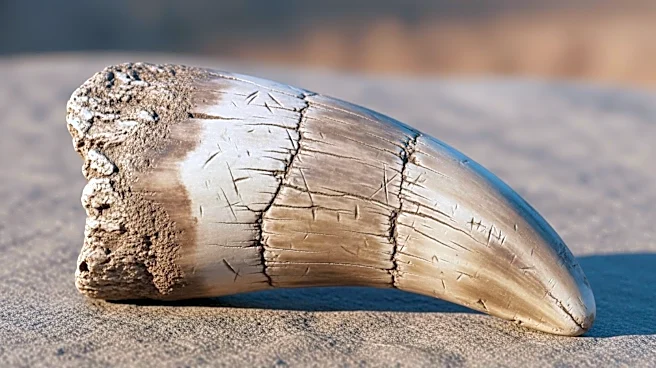
Recent research published in the Journal of Human Evolution has uncovered that Neanderthals, who lived in what is now France and Spain approximately 100,000 years ago, utilized rhinoceros teeth as tools. The study examined 281 fossilized rhino teeth from
Paleolithic cave sites, revealing grooves, fractures, and scrape marks that suggest these teeth were used for purposes beyond natural chewing patterns. Researchers conducted experiments using rhino teeth from French zoos, replicating Neanderthal tool usage, and confirmed their effectiveness as hammers and anvils for shaping stone tools. This discovery adds to the growing evidence that Neanderthals were more intelligent and resourceful than previously believed.
Why It's Important?
The findings challenge long-held perceptions of Neanderthals as primitive and unintelligent. By demonstrating their ability to create and use sophisticated tools, the study suggests that Neanderthals possessed cognitive abilities similar to Homo sapiens. This insight contributes to the broader understanding of human evolution, highlighting the complexity and adaptability of Neanderthals. The research also underscores the importance of revisiting historical assumptions about ancient human species, potentially influencing future studies in anthropology and archaeology.
What's Next?
Further research may explore other aspects of Neanderthal life, such as their social structures and cultural practices, to better understand their extinction and the survival of Homo sapiens. Scientists might also investigate the potential for Neanderthals to have engaged in trade or communication with other groups, which could provide additional insights into their societal dynamics. Continued exploration of Paleolithic sites may yield more artifacts that can shed light on the daily lives and technological advancements of Neanderthals.
Beyond the Headlines
The study raises ethical considerations about how intelligence and adaptability are measured in ancient species. It challenges the stereotype of Neanderthals as 'lesser' humans, prompting a reevaluation of how historical narratives are constructed. Additionally, the research may influence cultural perceptions, encouraging a more nuanced view of human ancestry and the diverse paths of evolution. This could lead to broader discussions about the value of diversity and adaptability in human history.