
What's Happening?
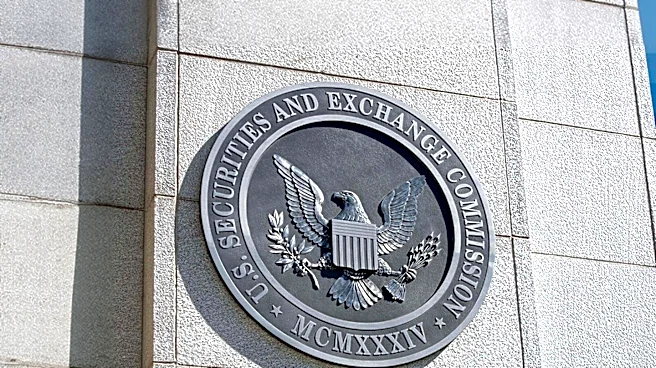
On June 4, 2026, the U.S. Supreme Court issued a unanimous decision in Sripetch v. SEC, ruling that the Securities and Exchange Commission (SEC) is not required to demonstrate that investors suffered pecuniary
loss before obtaining disgorgement. Justice Neil Gorsuch authored the opinion, stating that when misconduct enriches a defendant without leaving a victim worse off, equity traditionally favors stripping the gain rather than allowing the defendant to retain it. This decision resolves a split among federal circuit courts, specifically between the First and Ninth Circuits and the Second Circuit, which had previously mandated proof of loss in cases like SEC v. Govil (2023). The case involved Ongkaruck Sripetch, who engaged in fraudulent schemes across at least 20 penny-stock companies, with the SEC seeking over $4.1 million in disgorgement. This ruling marks a significant development in the SEC's enforcement powers regarding ill-gotten gains.
Why It's Important?
This Supreme Court decision significantly strengthens the SEC's ability to pursue and recover ill-gotten gains from fraudulent activities. By removing the requirement to prove investor pecuniary loss, the ruling streamlines the disgorgement process, potentially leading to more efficient and successful enforcement actions against wrongdoers. This is particularly impactful in cases where financial harm to individual investors is difficult to quantify or trace, but the defendant's illicit profits are clear. The decision reinforces the principle that individuals should not profit from unlawful conduct, even if a direct victim loss cannot be precisely calculated. This could deter future fraudulent schemes by ensuring that the financial incentives for such activities are removed. The ruling also provides greater clarity and consistency in the application of disgorgement remedies across different federal circuits, reducing legal ambiguities for both the SEC and defendants in securities fraud cases.
What's Next?
The Supreme Court's decision in Sripetch v. SEC is expected to influence future SEC enforcement strategies, potentially leading to an increase in disgorgement actions, especially in cases where proving direct investor loss has been a challenge. While the Court affirmed the SEC's power to obtain disgorgement without proving investor loss, it left open questions regarding whether disgorgement is available when distribution to investors is infeasible and whether disgorgement under the new statutory provision must be tied to specific victims. These unresolved issues may become subjects of future litigation. The ruling could also prompt a re-evaluation of how other regulatory bodies, particularly those dealing with privacy and data cases where gain often occurs without measurable financial loss, approach similar remedies. The SEC will likely leverage this expanded authority to pursue a broader range of misconduct, focusing on the defendant's unjust enrichment.
Beyond the Headlines
The Sripetch v. SEC ruling highlights a broader legal and ethical debate about the nature of justice in financial misconduct. By prioritizing the stripping of ill-gotten gains over the explicit demonstration of victim loss, the Court emphasizes a preventative and deterrent approach to fraud. This decision could have ripple effects beyond securities law, influencing how 'disgorgement' is applied in other areas, such as privacy, competition, and data cases, where proving direct financial harm to individuals can be complex. The concept of 'algorithmic disgorgement,' where companies are required to delete models and data derived from unlawfully collected information, is an emerging area that could see increased attention following this ruling. The decision underscores the judiciary's role in adapting traditional equitable remedies to modern forms of financial and technological misconduct, ensuring that wrongdoers do not benefit from their illegal actions, regardless of the direct impact on victims.