







What's Happening?
Luis Enrique Barragan, known as 'El Guicho' or 'R5,' a leader of the Cartel de Los Reyes, a faction of the Carteles Unidos, was killed in Mexico by security forces. The Mexican Secretary of Security, Omar Garcia Harfuch, announced on Tuesday that Barragan and
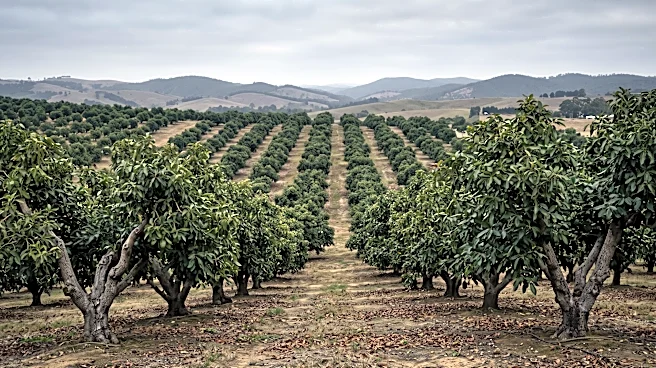
another individual were shot dead after assaulting military personnel and National Guard agents in Tocumbo, Michoacan state. The U.S. had offered a $3 million reward for information leading to Barragan's capture. According to the U.S. State Department, Barragan was a known 'sicario' (hitman) and operational leader who used drug trafficking profits to fund criminal operations and acquire light weapons to fight rivals from the Jalisco Nueva Generacion Cartel. In 2023, a U.S. federal court had indicted Barragan for conspiracy to traffic drugs and weapons. He was also identified as the primary coordinator for extorting avocado producers in the region and was subject to an extradition warrant to the U.S.
Why It's Important?
The death of Luis Enrique Barragan, a cartel leader wanted by the U.S., marks a significant development in the ongoing efforts to combat transnational organized crime and drug trafficking that directly impacts the U.S. The U.S. government's offer of a $3 million reward and the federal indictment against Barragan underscore the importance placed on disrupting these criminal networks. His role in financing criminal operations and acquiring weapons for cartel conflicts highlights the violent nature of these organizations and their threat to regional stability, which can spill over into U.S. border security and public safety. Furthermore, Barragan's involvement in extorting avocado producers illustrates the economic impact of cartel activities, affecting legitimate industries and potentially influencing trade relations between Mexico and the U.S. This event demonstrates the continued collaboration between U.S. and Mexican authorities in targeting high-value cartel figures.
What's Next?
The death of 'El Guicho' may lead to a power vacuum or a reshuffling of leadership within the Cartel de Los Reyes and the broader Carteles Unidos. This could potentially result in increased internal conflicts among rival factions vying for control, or it could lead to a temporary disruption in their operations. U.S. and Mexican authorities will likely continue their efforts to dismantle these criminal organizations, focusing on other key leaders and financial networks. The U.S. Department of State and other federal agencies will likely continue to offer rewards for information on other wanted cartel figures. The incident may also prompt further discussions and strategies between the U.S. and Mexico regarding cross-border security, intelligence sharing, and joint operations to combat drug and arms trafficking, as well as extortion activities that affect U.S. economic interests.
Beyond the Headlines
The killing of a cartel leader like Barragan, who was involved in both drug and arms trafficking and extortion, highlights the complex and multifaceted nature of organized crime. The U.S. designation of Carteles Unidos as a terrorist group underscores the severe threat they pose, blurring the lines between traditional criminal enterprises and more destabilizing forces. The extortion of avocado producers, a major agricultural export to the U.S., reveals how cartel influence extends beyond illicit drugs to impact legitimate economic sectors, potentially affecting consumer prices and supply chains in the U.S. This incident also brings to light the inherent dangers faced by Mexican security forces in confronting these heavily armed and violent groups, and the ongoing challenges in maintaining law and order in regions heavily impacted by cartel activity. The long-term implications involve not just law enforcement but also economic stability and regional governance.