







What's Happening?
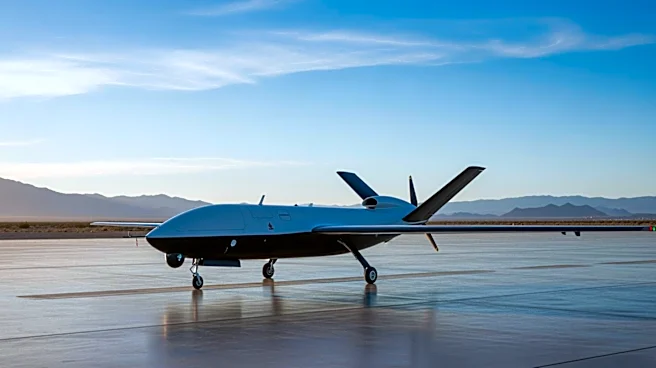
The Pentagon and the Netherlands Ministry of Defence have entered into a partnership to develop a prototype collaborative combat aircraft (CCA) in the United States. This agreement aims to enhance interoperability between the two nations, focusing on open-architecture
autonomous capabilities that can share data in combined operations. The Netherlands will acquire a prototype CCA aircraft as part of this collaboration, contributing to development work in the USA. This partnership builds on a letter of intent signed in October 2025, emphasizing the importance of interoperability and shared advantage in human-machine teaming. The Netherlands will work with the USAF’s Experimental Operations Unit (EOU), which is developing CCA operational concepts. The EOU has recently conducted exercises with the Anduril Industries YFQ-44A, which is competing in the USAF’s CCA Increment 1 competition.
Why It's Important?
This partnership signifies a strategic move towards enhancing military capabilities through international collaboration. By focusing on interoperability, the agreement aims to ensure that allied forces can operate seamlessly together in future conflicts. This is particularly important in the era of human-machine teaming, where autonomous systems are expected to play a significant role in military operations. The collaboration also reflects a broader trend of nations working together to develop advanced military technologies, which could lead to more efficient and effective defense strategies. For the U.S., this partnership strengthens ties with European allies and enhances its position in global defense innovation.
What's Next?
The Netherlands' commitment to the CCA effort follows similar international collaborations, such as the recent announcement by Australia and Japan to conduct CCA activities using the Boeing Defense Australia MQ-28A Ghost Bat. As the development progresses, the focus will likely be on testing and refining the prototype CCA aircraft to ensure it meets the operational requirements of both nations. The success of this partnership could lead to further collaborations and the development of more advanced autonomous military systems. Additionally, other countries may be encouraged to join similar initiatives, further enhancing global military interoperability.