






What's Happening?
The Trump administration is moving to challenge the American Bar Association's (ABA) long-standing authority to accredit law schools, a power it has held since 1952. The White House and congressional Republicans allege that the ABA is using its dominant
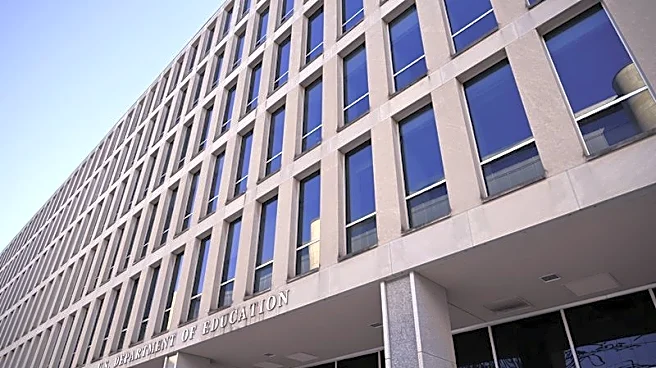
role in legal education to promote diversity, equity, and inclusion (DEI) ideology. A 500-page Department of Education report, obtained by The Wall Street Journal, suggests that the ABA's accreditation arm is not sufficiently independent from the legal profession itself. The Department of Education stated that its review found the ABA's accreditation standards to be 'out of compliance' with federal regulations. This initial recommendation to reject the ABA as a federally recognized accreditor will proceed to an independent, bipartisan advisory committee for review in September. The ABA's Council of the Section of Legal Education and Admissions to the Bar is currently the sole accreditor of Juris Doctor programs recognized by the Department of Education, and graduation from an ABA-approved law school is typically required to take the bar exam in most states.
Why It's Important?
This action by the Trump administration could significantly impact legal education and the legal profession in the U.S. The ABA's accreditation system grants it substantial influence over law schools, as only accredited universities can participate in federal student financial assistance programs under the Higher Education Act of 1965. If the ABA were to lose its federal recognition, students attending non-accredited law schools would no longer have access to federal student loans or grants. This could create considerable financial hurdles for prospective law students and potentially reshape the landscape of legal education. Furthermore, the move highlights a broader ideological conflict regarding the role of DEI initiatives within professional organizations and educational institutions, reflecting a pushback against such policies by the Trump administration and some Republican lawmakers. The outcome could redefine the standards and oversight of legal education, affecting both current and future lawyers.
What's Next?
The Department of Education's initial recommendation to reject the ABA's federal recognition will be reviewed by a panel, which will then make its own recommendation to Undersecretary of Education Nicholas Kent. Melissa Hart, chair of the ABA’s Accreditation Council, has stated that the council is complying with federal laws and regulations and looks forward to addressing any misconceptions at the upcoming hearing before the National Advisory Committee on Institutional Quality and Integrity. Under the Higher Education Act, the Secretary of Education has the authority to terminate an accrediting agency's federal recognition, but only after providing notice and an opportunity for a hearing. Accreditors are typically given up to 12 months to achieve compliance before termination. If the ABA's federal status is revoked, law schools affiliated with universities might use their university's accreditor to maintain access to federal student aid. However, freestanding law schools would face a more complex situation, as there are no other federally recognized accreditors specifically for J.D. programs, and the Trump administration has not detailed how these schools would retain federal aid access.
Beyond the Headlines
Beyond the immediate implications for law school accreditation, this development signals a deeper ideological battle over the influence of political and social agendas within professional bodies. The Trump administration's challenge to the ABA's authority, framed around concerns about DEI ideology, could set a precedent for similar actions against other professional organizations. This move could lead to a re-evaluation of the balance between academic freedom, professional standards, and governmental oversight in higher education. It also raises questions about the future of DEI initiatives in professional training and the potential for increased politicization of accreditation processes. The long-term impact could include a fragmentation of accreditation standards, a shift in the types of legal education offered, and a broader debate about the role of government in shaping educational curricula and professional ethics.