



What's Happening?
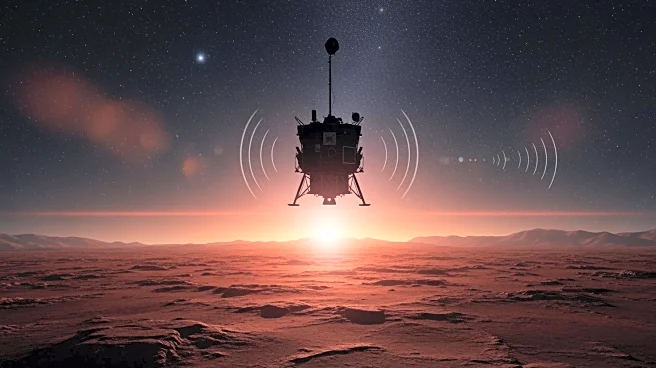
NASA has lost communication with its MAVEN spacecraft, which has been orbiting Mars since 2014. The probe, designed to study the Martian atmosphere and relay communications between Mars rovers and Earth, fell silent on December 6. Initial data suggests
the spacecraft may have been spinning unexpectedly. Efforts to re-establish contact have been unsuccessful, and NASA must wait until January 16 to attempt communication again due to Mars and Earth being on opposite sides of the sun. MAVEN has exceeded its original two-year mission, providing valuable insights into Mars' atmospheric loss and climate history.
Why It's Important?
The potential loss of MAVEN represents a significant setback for NASA's Mars exploration efforts. The spacecraft has been crucial in understanding the planet's atmospheric evolution, which is key to determining its past habitability. MAVEN's data has helped scientists piece together Mars' transformation from a potentially life-supporting environment to its current barren state. The communication breakdown also impacts the relay of data from surface rovers, potentially hindering ongoing and future Mars missions. The situation underscores the challenges of long-term space missions and the importance of maintaining robust communication systems.
What's Next?
NASA plans to attempt re-establishing contact with MAVEN on January 16, once the communication blackout ends. In the meantime, mission controllers are analyzing the last received data to diagnose the issue. The outcome of these efforts will determine the future of the MAVEN mission and its role in Mars exploration. If communication cannot be restored, NASA may need to rely more heavily on its other Mars orbiters, such as the Mars Reconnaissance Orbiter and Mars Odyssey, to continue its scientific and communication objectives.