
What's Happening?
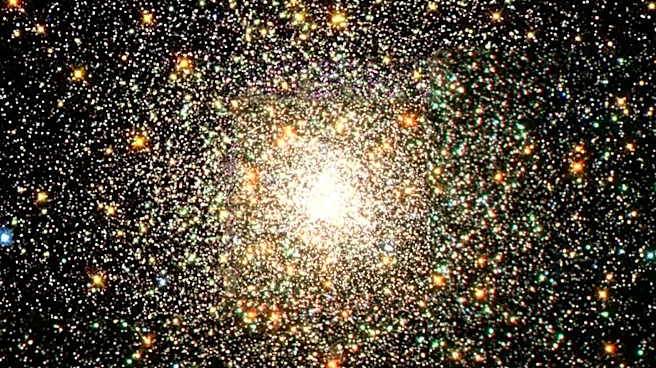
A team from the University of Utah, led by Matthew Whitaker, has successfully detected a stellar-mass black hole within the globular cluster Omega Centauri, located 18,000 light-years away. This discovery
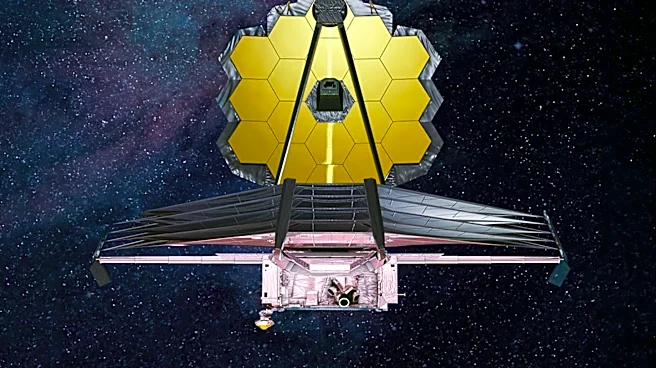
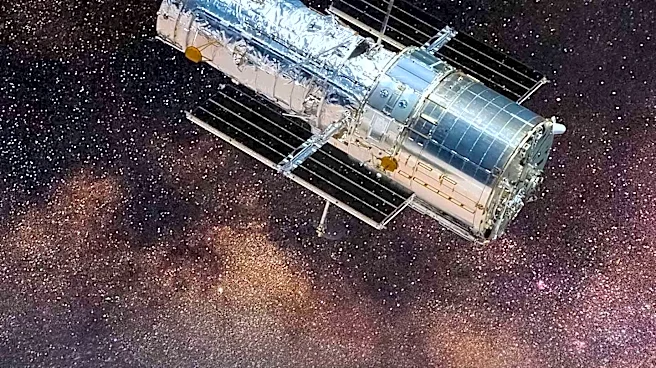
marks the first time such an object has been found in this cluster, resolving a decades-long search. The researchers utilized astrometry, a technique that tracks minute shifts in stars over time, combining data from the Hubble Space Telescope (collected over two decades from 2002 to 2023) and recent, highly precise infrared measurements from the James Webb Space Telescope. This combined approach allowed them to observe a star orbiting an invisible, yet massive, object, which they named oMEGACat BH-2. The black hole's mass is calculated to be 4.46 times that of the Sun, challenging previous assumptions that the object was a neutron star.
Why It's Important?
This discovery by Matthew Whitaker's team is significant for astrophysics as it confirms the existence of stellar-mass black holes in dense star clusters like Omega Centauri, a region previously thought to be devoid of such objects despite theoretical predictions of thousands. Traditional methods for detecting black holes, which rely on X-ray or radio emissions from accreting matter, were ineffective because this black hole is isolated and not actively consuming material. The successful application of astrometry, measuring gravitational influence through stellar movement, opens new avenues for detecting 'silent' black holes. This finding also challenges current theories of stellar evolution and black hole formation, particularly regarding their mass in low-metallicity environments. The unique 94-year orbital period of the binary system further complicates existing models, suggesting a need for revised theoretical frameworks.
What's Next?
The discovery of oMEGACat BH-2 is expected to spur further research into globular clusters and the mechanisms of black hole formation and evolution. Astronomers will likely focus on applying advanced astrometric techniques, potentially with next-generation telescopes, to search for more 'silent' black holes in other dense stellar environments. The anomalous mass and orbital characteristics of this black hole will prompt theoretical astrophysicists to refine their models of stellar collapse and binary system dynamics in low-metallicity regions. This could lead to a deeper understanding of the universe's early stages, as globular clusters are among the oldest structures. Future observations may also aim to identify additional black holes within Omega Centauri, providing a more comprehensive picture of its gravitational dynamics and stellar population.
Beyond the Headlines
The detection of oMEGACat BH-2 by Matthew Whitaker's team extends beyond a mere astronomical finding; it represents a triumph of scientific ingenuity and technological advancement. The successful integration of data from two powerful space telescopes, Hubble and James Webb, highlights the critical role of collaborative and long-term observational efforts in pushing the boundaries of human knowledge. This discovery underscores the universe's capacity to surprise and challenge our established scientific paradigms, reminding us that our understanding of cosmic phenomena is continually evolving. Ethically, it reinforces the value of persistent scientific inquiry and the pursuit of knowledge for its own sake, contributing to humanity's broader comprehension of its place within the cosmos. Culturally, such discoveries inspire awe and wonder, fostering public interest in science and space exploration.