







What's Happening?
The U.S. Army's Defense Ordnance Technology Consortium has awarded Perpetua Resources up to $40 million to conduct a feasibility study on producing tungsten concentrate at the Stibnite Mining District in Idaho. Perpetua Resources is required to match
the government's contribution, bringing the total planned investment to $80 million over a 36-month period. This program will involve exploration drilling, laboratory testing, engineering, and permitting work to assess the viability of tungsten concentrate production at the historic mining site. The initial 18-month phase is budgeted at $18 million, with Perpetua and the government each contributing equally. Subsequent phases will depend on technical results and further funding approvals. Previous drilling in the proposed Hangar Flats pit has already identified significant tungsten deposits, with grades of 4.6 percent tungsten over 9.8 meters and 1.2 percent tungsten over 22.9 meters.
Why It's Important?
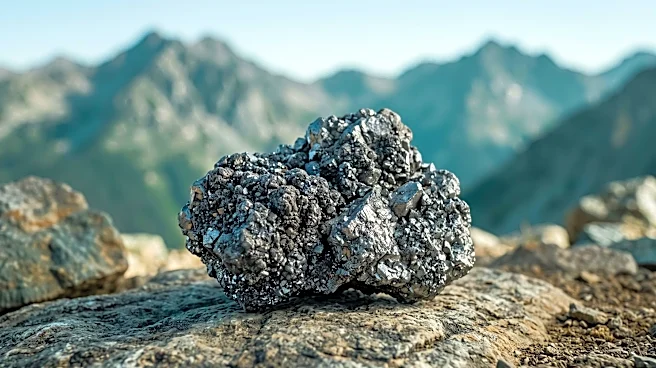
This initiative is crucial for bolstering the U.S. defense industrial base, as the nation has not had commercial tungsten mining since 2015. This reliance on imports from a limited number of suppliers makes the U.S. vulnerable to potential export controls, particularly from countries like China. Tungsten is an essential material due to its exceptional hardness and high-temperature resistance, making it vital for defense components, industrial cutting tools, and specialized alloys. The Stibnite district has a historical precedent, having supplied approximately half of the U.S.'s tungsten and 90 percent of its antimony during World War II. A successful domestic tungsten production operation would significantly reduce supply chain risks for defense manufacturing and help meet federal sourcing requirements for critical materials, enhancing national security and economic independence in this strategic sector.
What's Next?
The program's immediate next steps involve metallurgical testing to determine the efficiency of recovering tungsten and antimony from Stibnite's deposits, which is critical for establishing commercial mine economics. A 550-kilogram sample, grading 4.2 percent tungsten and 9.2 percent antimony, is slated for testing to assess processing efficiency and recovery rates. Depending on the drilling results and approvals, future work could include designing and permitting an underground exploration decline to access mineralization beneath Hangar Flats. This award increases the total U.S. government funding to Perpetua for critical minerals work to $126 million since 2022, providing capital for exploration and feasibility activities. However, the award does not grant approval for commercial mining; revenue generation remains contingent on successful feasibility outcomes, additional permitting, and separate development and production funding. The $40 million is a ceiling value, with obligated funding for each phase dependent on technical results, metallurgical testing, and government approval for continued work.
Beyond the Headlines
The broader implications of this project extend to the U.S.'s long-term strategy for critical mineral independence and supply chain resilience. The renewed focus on domestic sourcing of materials like tungsten highlights a shift away from global dependencies that can be exploited by geopolitical rivals. This effort could stimulate investment in other domestic mining and processing capabilities for critical minerals, potentially revitalizing rural economies in regions with historical mining activity. Furthermore, the project's success could set a precedent for how the U.S. government partners with private industry to secure strategic resources, balancing economic incentives with environmental considerations and regulatory oversight. The emphasis on feasibility studies before full-scale mining also underscores a more cautious and data-driven approach to resource development, aiming to ensure both economic viability and responsible environmental stewardship.