
What's Happening?
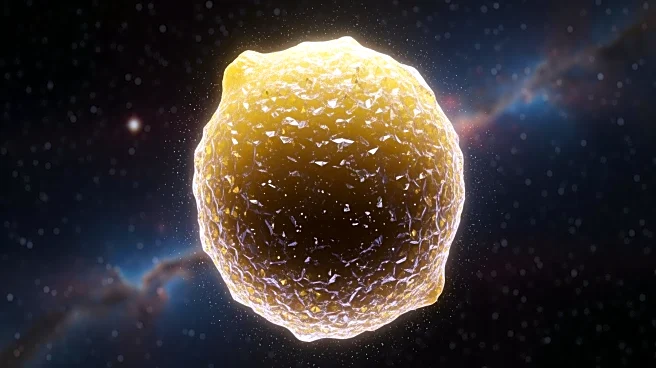
Astronomers have identified an unusual exoplanet, PSR J2322-2650b, located 2,000 light years from Earth. This celestial body is notable for its lemon-like shape and a unique atmosphere dominated by helium
and carbon. The planet orbits a pulsar at a distance of about 1 million miles, which is significantly closer than Earth's distance to the Sun. The intense gravitational pull from the pulsar is believed to have elongated the planet into its distinctive shape. The atmosphere of PSR J2322-2650b is so exotic that it might allow carbon clouds to condense into diamonds, a phenomenon not observed in any other known planetary atmosphere. This discovery challenges existing theories about planetary formation and atmospheric composition.
Why It's Important?
The discovery of PSR J2322-2650b is significant as it expands the understanding of planetary diversity and formation. The planet's unique characteristics, such as its shape and atmospheric composition, provide new insights into the effects of extreme gravitational forces on celestial bodies. This could lead to a reevaluation of current models of planetary atmospheres, particularly those involving carbon and helium. The potential for diamond rain on the planet also opens up discussions about the mineralogical processes that can occur under extreme conditions. This finding could influence future astronomical research and the search for other exotic planets in the universe.
What's Next?
Further studies are likely to focus on understanding the mechanisms that allow for the presence of free-floating carbon in the planet's atmosphere. Researchers may also explore the implications of such atmospheric conditions for the planet's potential habitability or resource utilization. Observations using advanced telescopes and space missions could provide more detailed data on PSR J2322-2650b and similar exoplanets. The scientific community may also investigate the possibility of other planets with similar characteristics, which could redefine the criteria for classifying celestial bodies.
Beyond the Headlines
The discovery of PSR J2322-2650b raises questions about the potential for life in extreme environments. While the planet's conditions are inhospitable by Earth standards, understanding its atmospheric processes could inform the search for life in the universe. Additionally, the presence of diamond rain suggests that valuable resources might exist on other planets, which could have implications for future space exploration and mining endeavors. This discovery also highlights the importance of interdisciplinary research in astronomy, combining elements of physics, chemistry, and planetary science.