
What's Happening?
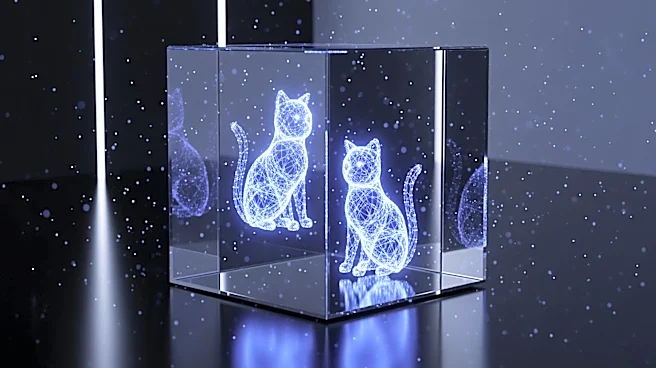
The concept of Schrödinger’s kittens, an extension of the famous Schrödinger's cat thought experiment, is being used to explore the limits of quantum mechanics. Researchers are testing whether quantum mechanics can
be applied to larger objects, potentially revealing where quantum behavior breaks down. This involves creating superpositions in objects as large as tiny crystals, which could help resolve foundational questions about the universe, including the nature of gravity and dark matter.
Why It's Important?
These experiments are crucial for understanding the fundamental nature of reality. By testing the limits of quantum mechanics, scientists hope to uncover whether the principles of quantum theory apply universally or if there is a scale at which classical physics takes over. This research could lead to breakthroughs in quantum computing and provide insights into the unification of quantum mechanics and general relativity, two pillars of modern physics that currently remain incompatible.
What's Next?
Future experiments aim to create even larger quantum superpositions, potentially involving objects with enough mass to test the quantum nature of gravity. Success in these endeavors could pave the way for new technologies and deepen our understanding of the universe. Researchers are also exploring the possibility of using these experiments to detect dark matter or new forces of nature, which could revolutionize our understanding of the cosmos.
Beyond the Headlines
The pursuit of larger quantum superpositions raises philosophical questions about the nature of reality and observation. It challenges our understanding of existence and the role of the observer in determining the state of a system. These experiments also highlight the interplay between theoretical physics and experimental capabilities, pushing the boundaries of what is technologically possible.