






What's Happening?
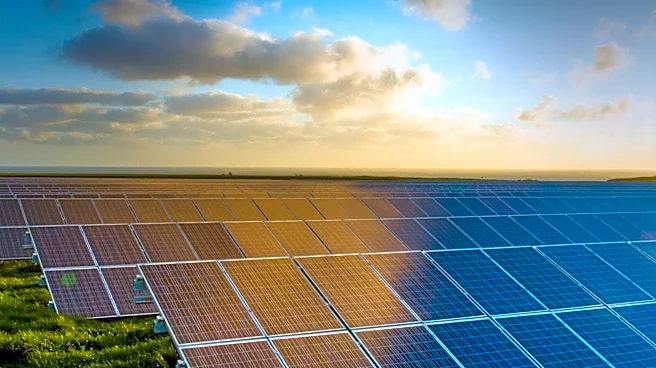
A recent international study, led by researchers from China and the U.S., has found that the expansion of solar panel policies across China is leading to a reduction in bird diversity. The study, published in the peer-reviewed journal Science, indicates
that wealthier and non-desert regions are experiencing the most significant loss of bird species. Researchers observed that solar expansion has encroached upon birds' foraging and breeding grounds, resulting in more fragmented habitats. This situation highlights a conflict between China's carbon reduction policies and biodiversity conservation efforts. The team also identified a phenomenon they termed 'inferior greening,' where an increase in leaf area does not necessarily correspond to improved wildlife habitat, prompting a reevaluation of ecological health in the context of renewable energy growth.
Why It's Important?
This study is important because it underscores a critical 'green dilemma' where efforts to combat climate change through renewable energy expansion can inadvertently harm local biodiversity if not meticulously planned. For the U.S., this research offers valuable insights into the potential environmental trade-offs of large-scale solar development, especially as the nation also pursues aggressive renewable energy goals. It suggests that without strict biodiversity safeguards and careful spatial planning, similar negative impacts on wildlife could occur domestically. The findings challenge the assumption that all 'greening' initiatives are inherently beneficial for ecological health, urging policymakers and environmental planners to consider the broader ecological consequences of renewable energy infrastructure. This could influence future U.S. policy discussions on renewable energy siting and environmental impact assessments.
What's Next?
The researchers advocate for future photovoltaic development to incorporate strict biodiversity safeguards, particularly in economically developed regions with complex habitats. This recommendation suggests that policymakers in China and potentially other nations, including the U.S., may need to revise their strategies for solar energy deployment. Future steps could involve more comprehensive environmental impact assessments before approving large-scale solar projects, and the implementation of mitigation measures to protect critical wildlife habitats. There may also be increased research into alternative solar technologies or deployment methods that minimize ecological disruption. The study's findings could also spur international collaboration on best practices for balancing renewable energy expansion with biodiversity conservation.
Beyond the Headlines
Beyond the immediate environmental concerns, this study touches upon the complex ethical and policy challenges inherent in the global pursuit of sustainability. It highlights that 'green' solutions are not always uniformly beneficial and can create new environmental problems if not approached holistically. The concept of 'inferior greening' suggests a deeper issue where superficial environmental metrics might mask underlying ecological degradation. This could lead to a re-evaluation of how ecological health is defined and measured in the context of renewable energy projects. The findings also raise questions about the long-term effectiveness of carbon reduction policies if they come at the cost of significant biodiversity loss, potentially triggering a broader debate on the true cost of climate action and the need for integrated environmental planning that considers all facets of ecological well-being.