







What's Happening?
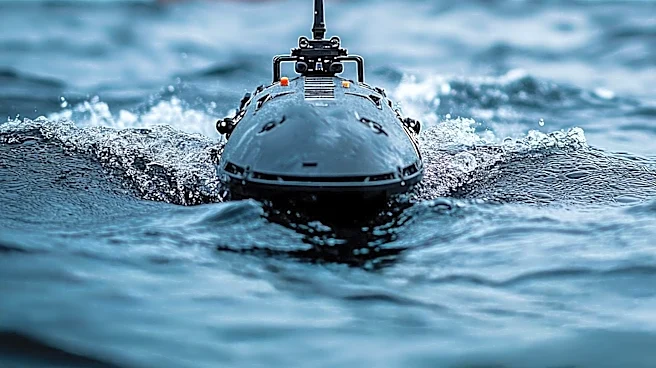
German defense technology startup Stark Defence is set to launch a new 24-meter unmanned surface vessel (USV), designated Vanta 24, in 2027. This development was announced by the Berlin-based company during Bloomberg Tech London on November 3. The Vanta 24 is designed
to protect critical underwater infrastructure and monitor Russia's 'shadow fleet' in European waters. According to Stark Defence CEO Uwe Horstmann, this autonomous platform offers a significantly cheaper and faster-to-deploy alternative to conventional crewed warships, costing a thousandth of the price of a manned frigate and deployable within months. The Vanta 24 will be capable of carrying payloads up to 50 metric tons, including weapons like missiles and cannons, and can reach speeds exceeding 40 miles per hour without a crew. This initiative comes as European countries increasingly seek autonomous maritime systems to bolster naval security amid growing concerns over Russian activities.
Why It's Important?
The introduction of the Vanta 24 by Stark Defence represents a significant advancement in maritime security and defense technology, particularly in response to heightened concerns over Russian naval activities and threats to critical infrastructure in European waters. The cost-effectiveness and rapid deployment capabilities of unmanned surface vessels like the Vanta 24 offer a strategic advantage, allowing for more extensive surveillance and protection of vast maritime areas compared to traditional, more expensive crewed vessels. This development underscores a broader European trend towards adopting autonomous systems to enhance naval deterrence and counter emerging threats. By focusing on protecting underwater infrastructure and monitoring the 'shadow fleet,' Germany and its European partners are directly addressing vulnerabilities that have become increasingly apparent through cyberattacks, drone incursions, and suspected sabotage incidents, thereby contributing to regional stability and security.
What's Next?
Stark Defence, which originated as a manufacturer of strike drones, is expanding its product portfolio with the Vanta 24, aiming to establish itself as a comprehensive defense technology supplier. In addition to the USV, the company is developing an electronic warfare sensor capable of detecting transmitters and radar systems up to 100 kilometers away, further enhancing its surveillance capabilities. Stark is also working on a software platform to enable communication between unmanned aerial and maritime systems, with potential integration of weapons and equipment from other manufacturers. These developments indicate a future where integrated networks of autonomous systems play a central role in maritime defense. The deployment of the Vanta 24 in 2027 will be a critical test of its operational effectiveness in challenging environments like the Baltic and North seas, which are characterized by difficult weather conditions.
Beyond the Headlines
The rise of unmanned maritime systems like the Vanta 24 signals a paradigm shift in naval warfare and surveillance, moving towards more autonomous and networked defense strategies. This technological evolution could democratize access to advanced maritime capabilities, allowing smaller nations or specialized units to deploy sophisticated surveillance and interdiction assets at a fraction of the cost of traditional naval fleets. However, it also raises complex questions regarding command and control, accountability for autonomous actions, and the potential for escalation in maritime conflicts. The focus on Russia's 'shadow fleet' highlights the growing challenge of identifying and monitoring non-state or ambiguously affiliated maritime actors, which could complicate international maritime law and enforcement. Furthermore, the development of such systems could spur a new arms race in autonomous naval technologies, prompting other nations to invest heavily in similar capabilities to maintain strategic parity.