







What's Happening?
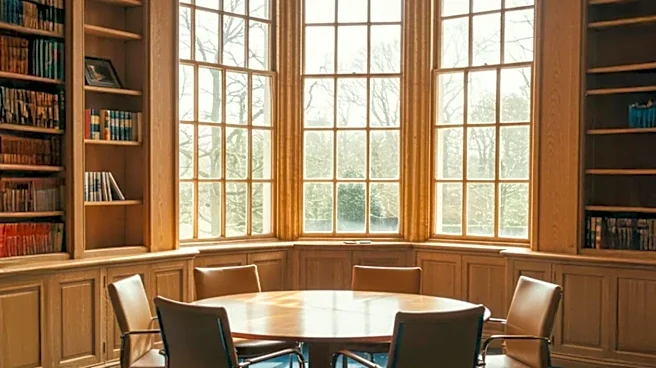
Princeton University's Lewis Science Library provides a dedicated quiet space known as the Calm Room, available to all Princeton-affiliated patrons. This room is designed for individuals seeking a tranquil environment for study and reflection. In addition
to the Calm Room, the library also offers nine group study rooms and a unique space called the Treehouse, which requires booking requests to be reviewed and discussed before approval. The Lewis Science Library is situated within The Peter B. Lewis Library building, located at the intersection of Washington Street and Ivy Lane in Princeton. The availability of these spaces can be checked through an interactive calendar, with floor maps provided for Levels 2, 3, and 4 to help patrons navigate the library's offerings. The library aims to cater to various study needs, from collaborative group work to individual quiet concentration.
Why It's Important?
The provision of dedicated quiet spaces like the Calm Room at Princeton University is significant for fostering an optimal academic environment. Such spaces are crucial for students and faculty who require minimal distractions to engage in deep work, research, and focused study. In a university setting, where collaboration is often encouraged, having designated areas for silent individual work helps balance diverse learning styles and needs. This initiative supports mental well-being by offering a retreat from potentially noisy common areas, thereby reducing stress and enhancing concentration. For the academic community, access to such facilities can directly impact productivity, learning outcomes, and overall academic success, reinforcing the library's role as a central hub for intellectual pursuits.
What's Next?
As academic institutions continue to adapt to evolving student needs, the demand for diverse study environments, including quiet zones, is likely to persist. Princeton University will likely continue to monitor the usage and effectiveness of spaces like the Calm Room to ensure they meet the community's requirements. Future developments might include expanding similar quiet zones in other library branches or academic buildings, incorporating user feedback to refine existing spaces, or integrating technology that enhances the quiet study experience, such as noise-canceling features or advanced booking systems. The ongoing availability and potential expansion of such facilities will remain a key aspect of supporting student well-being and academic achievement within the university.
Beyond the Headlines
The trend of academic libraries offering specialized quiet rooms reflects a broader understanding of cognitive needs and mental health in educational settings. Beyond simply providing books, modern libraries are evolving into comprehensive learning environments that cater to various psychological and physiological requirements for effective study. The concept of a 'Calm Room' goes beyond mere silence; it often implies an environment designed to reduce sensory overload, promoting a sense of peace and focus. This approach acknowledges that learning is not just about information absorption but also about creating the right mental state. Such initiatives contribute to a more inclusive and supportive educational ecosystem, recognizing that different individuals thrive in different environments, and providing options can significantly enhance overall academic performance and student satisfaction.