



What's Happening?
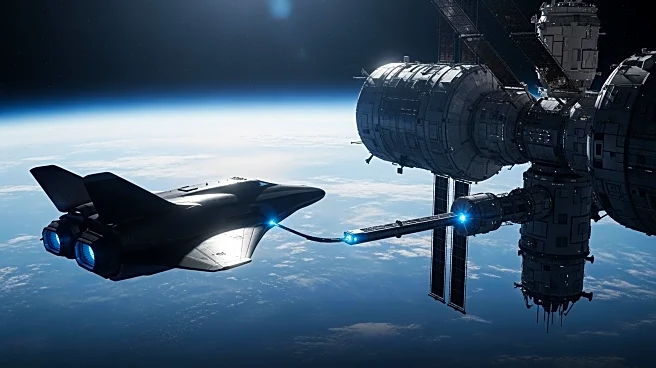
SpaceX's Crew-12 mission successfully docked with the International Space Station (ISS) on February 14, 2026, at 3:15 p.m. EST. The docking concluded a 34-hour orbital chase, marking a significant milestone in space exploration. The Crew-12 mission, led
by NASA's Jessica Meir, includes astronauts Jack Hathaway, Sophie Adenot from the European Space Agency, and Roscosmos cosmonaut Andrey Fedyaev. This mission aims to bolster the ISS's crew capacity, which had been reduced following the medical evacuation of Crew-11 due to an undisclosed health issue. The Crew-12 team will join the existing skeleton crew for an eight-month stay, contributing to ongoing scientific research and international collaboration aboard the ISS.
Why It's Important?
The successful docking of SpaceX's Crew-12 with the ISS is crucial for maintaining the station's operational capacity and advancing international space cooperation. This mission underscores the importance of partnerships between NASA, SpaceX, and international space agencies, highlighting the collaborative efforts required for sustained human presence in space. The addition of Crew-12 helps ensure the continuity of scientific experiments and technological advancements conducted on the ISS, which have far-reaching implications for space exploration and potential future missions to the Moon and Mars. The mission also demonstrates the reliability and effectiveness of commercial spaceflight in supporting governmental space initiatives.
What's Next?
With Crew-12 now aboard the ISS, the focus will shift to their integration into the station's operations and the continuation of scientific research. The crew will participate in various experiments and maintenance tasks, contributing to the ISS's role as a hub for international scientific collaboration. Future missions will likely build on the success of Crew-12, with plans for further crew rotations and potential expansions of the ISS's capabilities. The ongoing partnership between NASA, SpaceX, and international agencies will be pivotal in shaping the future of human space exploration, including potential missions beyond low Earth orbit.