



What's Happening?
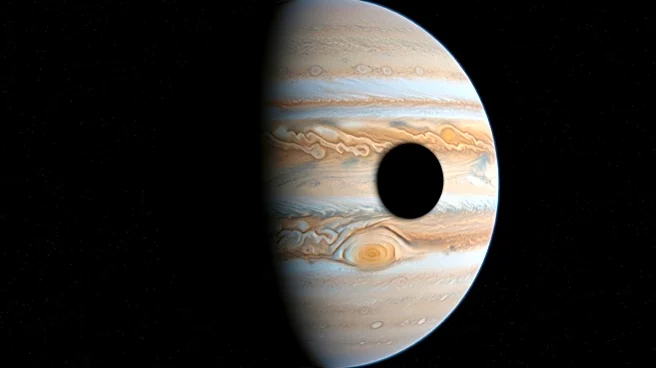
On December 31, 2025, a significant astronomical event will occur as Jupiter's icy moon Europa and its shadow transit across the planet's cloud tops. This event is set to begin at 9:01 P.M. EST when Europa's shadow appears on Jupiter's southeastern limb.
Europa itself will follow 28 minutes later, and both will be visible crossing the gas giant for over two hours. The transit will conclude with Europa's shadow exiting Jupiter's disk just before midnight EST, while Europa will complete its transit approximately half an hour later. This celestial event coincides with Jupiter's approach to opposition, making it highly visible in the constellation Gemini at a magnitude of -2.7.
Why It's Important?
This transit of Europa is a notable event for astronomers and sky watchers, as it provides a unique opportunity to observe one of Jupiter's moons casting a shadow on the planet. Such events are significant for studying the dynamics of Jupiter's moons and their interactions with the planet. The visibility of this transit during a time when Jupiter is near opposition enhances its accessibility to amateur astronomers and enthusiasts, potentially increasing public interest in astronomy. The event also highlights the intricate dance of celestial bodies within our solar system, offering insights into gravitational interactions and orbital mechanics.
What's Next?
Following this event, astronomers and enthusiasts may look forward to more celestial phenomena as Jupiter continues its journey through the night sky. The approach of opposition means that Jupiter will remain a prominent feature in the sky, providing further opportunities for observation. Additionally, the transit of Europa may inspire increased interest in upcoming astronomical events, encouraging more people to engage with the night sky and explore the wonders of our solar system.
Beyond the Headlines
The transit of Europa across Jupiter not only captivates those interested in astronomy but also serves as a reminder of the vastness and complexity of our solar system. Events like these can inspire educational initiatives and public outreach programs aimed at fostering a deeper understanding of space science. They also underscore the importance of continued investment in astronomical research and technology, which can lead to new discoveries and advancements in our knowledge of the universe.